

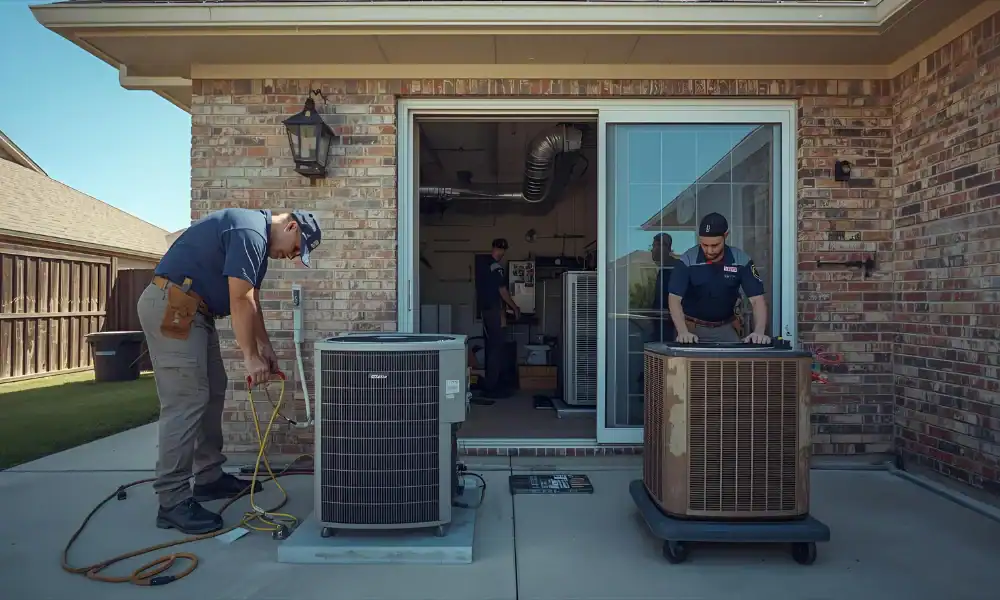
If you are looking for a new system in DFW, the biggest question on your mind is likely: “How long will I be without the AC?” In the notorious heat of a North Texas summer, every hour counts.
Replacing an HVAC system isn’t just a plug-and-play operation. It is a major construction project happening inside your home. While a standard swap might be wrapped up by dinner time, complex retrofits can stretch over multiple days.
This guide breaks down the typical HVAC installation day timeline for Dallas, Fort Worth, and surrounding suburbs, helping you plan your day, manage your family’s comfort, and know exactly what your contractor/technician should be doing at every hour.
Key Takeaways
|
DFW’s HVAC Installation Timeline: Setting the Right Expectations
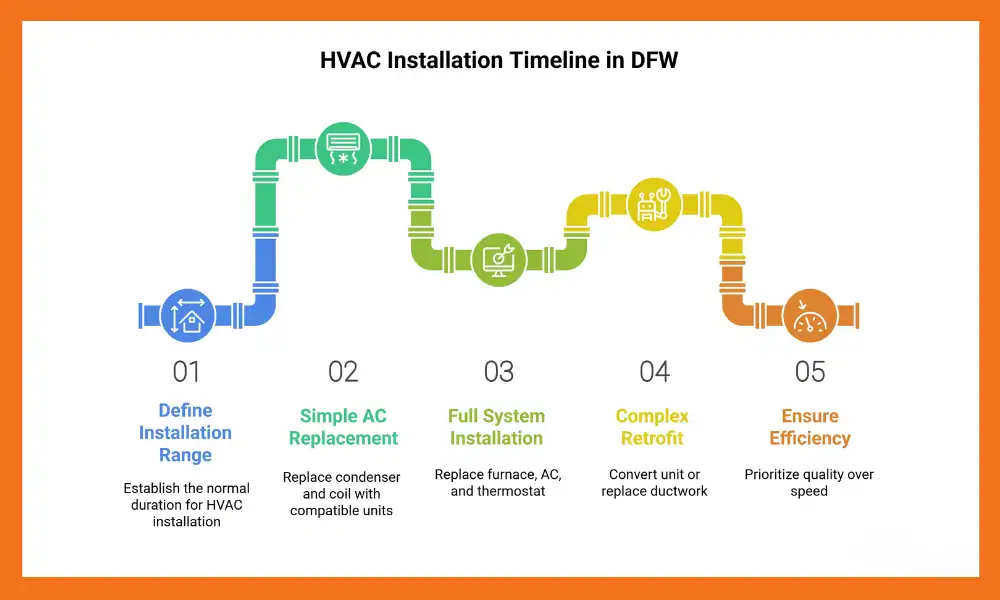
Before the crew arrives, it is critical to define the “normal” range for an HVAC installation in the Metroplex. The duration depends heavily on the type of replacement/upgrade. You can go for a simple component swap or a full system redesign to meet strict Energy Code Compliance in DFW.
Simple AC Replacement (The “Changeout”)
- Duration: 4-8 hours.
- Scenario: You are replacing an outdoor condenser and indoor coil with compatible units. The existing ductwork is in good shape, and no major electrical or gas line modifications are needed.
- Result: Install crew arrives at 8 AM; you have cool air by 4 PM.
Full System Installation (Furnace + AC + Minor Ductwork)
- Duration: 1-2 days.
- Scenario: You are replacing the furnace, AC (or heat pump), and thermostat. This often involves rebuilding the plenum (the air distribution box) or modifying the return air drop for better efficiency.
- Result: Most of the heavy lifting is done on day 1. Final commissioning or inspection prep may go into day 2.
Complex Retrofit (New Ductwork / Relocation)
- Duration: 3-5 Days.
- Scenario: Converting a closet unit to an attic system, replacing an entire house of ductwork, or upgrading to a complex VRF or zoned system.
Note: In DFW, speed should never compromise efficiency. A rushed job often leads to poor performance and higher energy bills. If you want a full DFW HVAC installation pricing breakdown, you should receive a line-item quote during the initial assessment.
Before Install Day: Your Contractor’s and Homeowner’s Checklist
The clock starts ticking long before the truck pulls into your driveway. The smoothness of HVAC installation on the scheduled day relies on preparation from both the contractor and the homeowner.
Navigating DFW Permit Processing and Inspection Scheduling
In cities like Dallas, Fort Worth, Plano, and Arlington, an HVAC replacement is a regulated construction project.
- The Permit: Your contractor is responsible for pulling the mechanical permit with the city. Do not hire a crew that asks you to pull the permit yourself. Understanding your local DFW air conditioner permit requirements is key to avoiding installation delays.
- The Inspection: After the installation is complete, a final mechanical inspection by a City Building Inspector is required to verify safety and code compliance. Your contractor handles this scheduling, but you will need to be home to let the inspector in.
Essential Home Prep for a Smooth DFW Install
You can shave hours off the timeline by ensuring the install crew has immediate, safe access to critical areas.
- Clear the Path: Move furniture, rugs, and wall art along the path to the attic access or furnace closet.
- Attic Access: If your unit is in the attic (common in North Texas), ensure the pull-down ladder is accessible and not blocked by storage boxes.
- Outdoor Access: Unlock the gate and clear vegetation around the outdoor condenser pad.
- Electrical Panel: Ensure the tech can easily reach your breaker box to perform the disconnect safety check.
The Hidden Variables: What Can Expand Your DFW HVAC Timeline?
Why do some jobs finish at 2 PM while others drag on? Several hidden variables can expand the timeline.
The 4-Hour Swap vs. the Multi-Day Retrofit
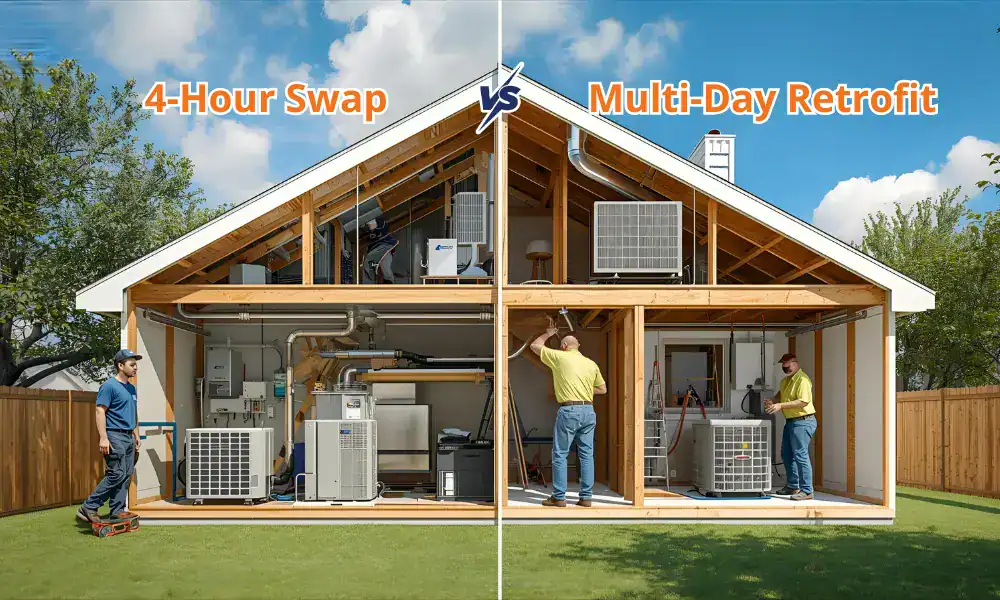
A direct swap of a condenser and evaporator coil is straightforward. However, if your pre-installation assessment revealed crushed, leaking, or undersized ducts, the crew must perform ductwork cleaning or replacement. Properly sealing and hanging new ducts in a 130°F attic is slow, methodical work that adds significant time but ensures long-term comfort.
Impact of System Type and Building Size
- Heat Pump Conversion: Switching from a gas furnace to an electric heat pump involves capping gas lines and running new high-voltage electrical circuits, adding 4+ hours to the job.
- Package Units: If you have a rooftop package unit HVAC (common in some DFW condos or older homes), a crane lift is required. Coordinating the crane arrival adds a logistical layer that can pause work.
- Attic Constraints: Tight attic spaces in older DFW homes slow down the removal of the bulky old system, requiring the crew to dismantle it piece by piece.
Morning (8:00 AM – 12:00 PM): The Tear-Out and Setup Phase
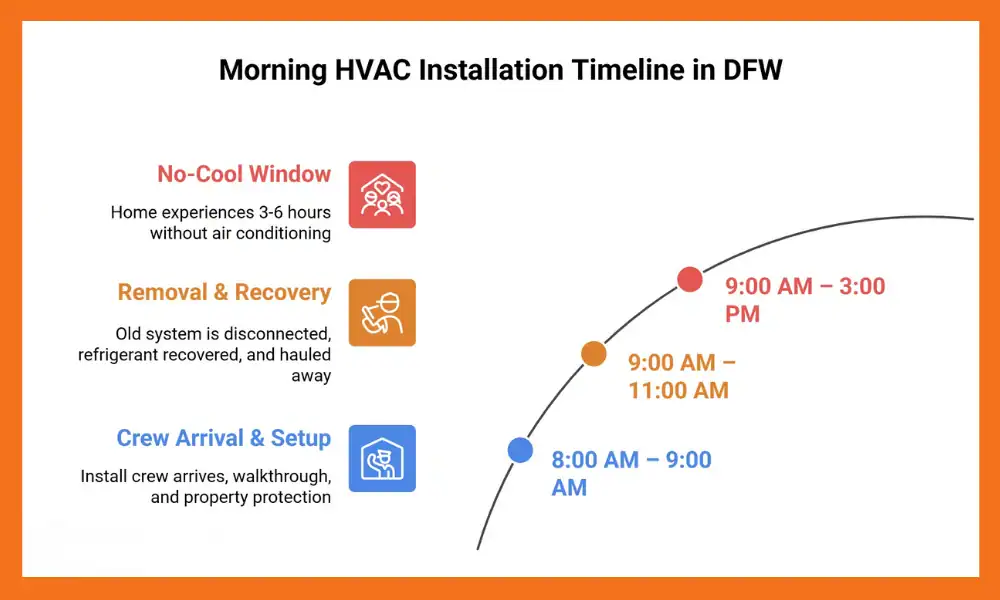
8:00 AM – 9:00 AM: Arrival and Protection
The install crew typically arrives within a one-hour window. The lead installer or install supervisor will do a quick walkthrough to confirm the plan. This is also when you might discuss the possibility of a next-day HVAC installation scheduling process if the complexity of the job requires more time than originally planned.
- Property Protection: The crew lays down drop cloths and applies floor protection to prevent damage.
- Safety Check: Power is cut at the disconnect box and electrical panel.
9:00 AM – 11:00 AM: Removal and Recovery
Before the old system can move, the crew must take care of refrigerant recovery.
- Environmental Safety: EPA regulations mandate that old refrigerant be pumped out into recovery cylinders and never vented into the atmosphere.
- Disconnects: Gas lines and electrical whips are disconnected.
- Haul Off: The bulky furnace and condenser are hauled away to the truck for recycling.
The “No-Cool” Window in Texas Summer
From the moment the power is cut (approx. 9:00 AM) until the new system is charged and tested (approx. 3:00 PM – 5:00 PM), your home will have zero cooling.
- Downtime: Expect 3-6 hours without AC.
- Tip: Pre-cool your home to 68°F–70°F the night before to build up a “thermal battery” that helps keep the house bearable until the new unit fires up.
Mid-Day (12:00 PM – 4:00 PM): New System Installation & Component Setting
This is the busiest phase where the HVAC system takes shape.
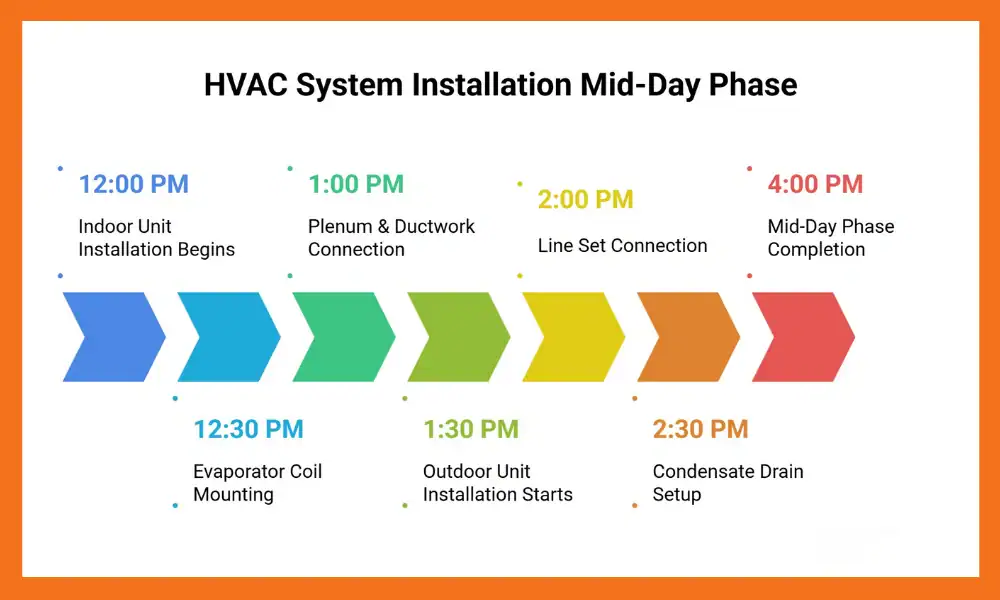
Indoor Unit Installation
- Furnace / Air Handler: The new unit is lifted into the attic or closet. It must be leveled perfectly to ensure proper drainage.
- Evaporator Coil: The coil is mounted on top of the furnace.
- Plenum & Ductwork: The crew connects the supply and return plenum to the unit. This is critical for airflow balancing. All connections are sealed with mastic to prevent air leaks, a key part of Energy Code Compliance.
Outdoor Unit Installation
- Condenser Pad: The crew levels the ground and places a new composite condenser pad to support the unit and reduce vibration.
- Line Set Connection: The copper line set (which carries refrigerant) is connected. The technician performs brazing using nitrogen to prevent oxidation inside the pipes.
- Condensate Drain Setup: A new drain line is run, often including a secondary drain pan and a float switch (ceiling saver) to shut the unit off if water backs up, preventing ceiling damage.
Late Afternoon (4:00 PM – 5:30 PM): Critical Testing and Commissioning
The physical work is done, but the system isn’t ready. This phase distinguishes a “box swapper” from a professional NATE-certified technician.
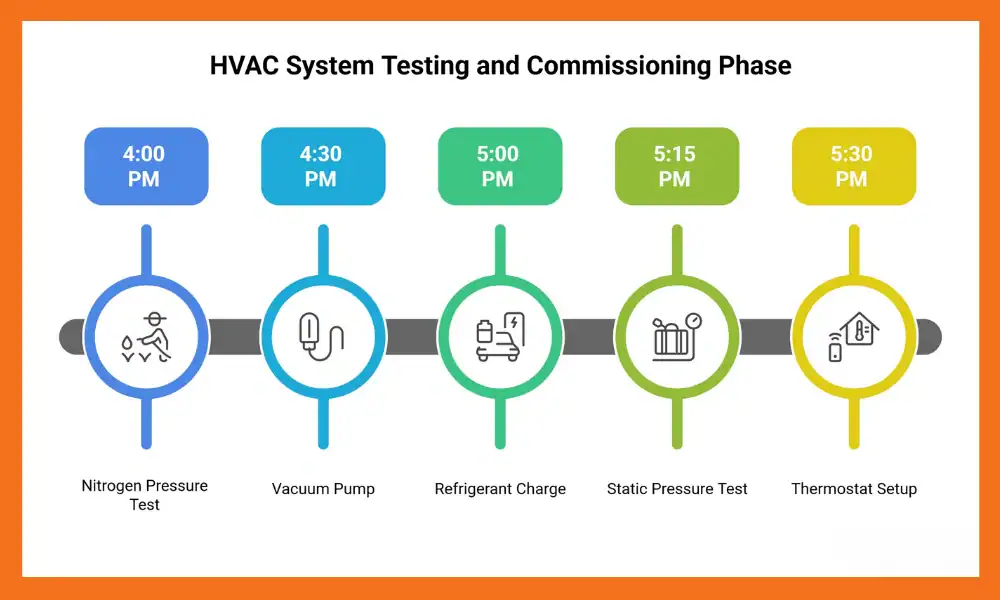
Pressure Testing and Vacuum
- Nitrogen Pressure Test: The system is pressurized with nitrogen to verify there are no leaks in the brazed joints.
- Vacuum Pump: A deep vacuum is pulled on the line set to remove moisture and non-condensables.
Charging and Calibration
- Refrigerant Charge: The crew releases the refrigerant. In the extreme heat of DFW, precise charging is vital. The technician measures superheat and subcooling to ensure the system absorbs and rejects heat efficiently.
- Static Pressure Test: This health check measures the resistance in your ductwork. High static pressure can kill a new blower motor; this test confirms your ducts can handle the airflow.
- Thermostat Setup: The new smart thermostat is installed, connected to Wi-Fi, and programmed.
Completion, Crew Roles, and Post-Install Follow-Up in DFW
As the sun sets, the supervisor will invite you for the final walkthrough.
The Walkthrough & Homeowner Education
- Visual Check: You’ll see the new unit, the sealed ducts, and the clean workspace.
- Education: The tech will show you how to change the filter, operate the thermostat, and where the emergency shut-offs are. This is the ideal time for understanding your HVAC installation quote fully, confirming that all work items have been addressed.
- Warranty Registration: The office typically handles registering your equipment serial numbers to ensure you get the full 10-year parts warranty.
What Comes Next?
- Cleanup: The crew removes all debris, old equipment, and trash.
- Inspection: Your contractor will schedule the final mechanical inspection with the city (usually a few days later) to close out the permit.
- Comfort: You can finally set the temp to 72°F and enjoy the efficiency and quiet performance of your new system. Be sure to ask your contractor about low-payment HVAC financing programs if you need to manage the investment over time.
Frequently Asked Questions (FAQs)
How long does HVAC installation take in DFW?
A basic AC replacement typically takes 4-8 hours, while a full HVAC system install often requires 1-3 days, depending on ductwork complexity.
Do I need to be home during HVAC installation?
The homeowner should be present for the morning arrival and the final walkthrough/commissioning; you can usually step out during the middle of the day if needed.
What time will the HVAC crew arrive in DFW?
Most install crews arrive within a designated arrival window, typically between 8:00 AM – 9:00 AM to beat the midday heat.
What is the “no-cool” window during a Texas summer install?
Your home will be without AC for approximately 3-6 hours during the tear-out and new line set connection phase.
Who schedules the city inspection for HVAC in DFW?
Your licensed contractor is responsible for pulling the permit and scheduling the final mechanical inspection with the city building department.
What makes an HVAC installation a “two-day” job?
Jobs extend to two days if they involve extensive ductwork replacement, complex heat pump conversions, or attic access issues that slow down the removal process.
What happens to my old AC and Furnace?
The crew performs refrigerant recovery, dismantles the old system, and hauls all equipment away for proper recycling.
Can I use my new thermostat right after installation?
Yes, the thermostat will be fully calibrated, connected, and demonstrated to you during the final commissioning phase before the crew leaves.