

Last summer in Dallas, I stood in a living room where the thermostat read 78°F, even though the AC had been running all day. The homeowner pointed at the EnergyGuide label and said, It says high efficiency.
Why does it feel like this? I’ve heard that question more times than I can count. A few years ago, the answer usually came down to SEER. Today, it’s SEER2.
When efficiency ratings changed, many homeowners felt confused. Numbers dropped. Contractors used new terms. Energy bills kept rising. In North Texas heat, that combination creates real frustration.
I’ve walked through homes where the system looked perfect on paper but struggled in real conditions. Even picking the right size for your home is the most important decision. That’s when SEER2 started making sense.
Efficiency isn’t just about a number anymore. It’s about airflow, duct pressure, sizing, and how your home actually behaves on a 100-degree afternoon. Once you understand that shift, the ratings stop feeling confusing and start feeling useful.
| Key Takeaways:
|
What Is a SEER Rating?
SEER measures how efficiently an air conditioner cools over a season.
SEER stands for Seasonal Energy Efficiency Ratio. It compares cooling output to electricity used. Higher SEER means better efficiency and lower energy bills. I explain this first because SEER affects comfort, cost, and long-term value.
SEER equals total cooling output divided by total electricity used during a cooling season. Formula:
SEER = Seasonal Cooling Output (BTUs) ÷ Energy Used (Wh)
For example, a 16 SEER system delivers 16 BTUs of cooling per watt-hour. I often use this formula to help homeowners understand why efficiency matters.
SEER ratings directly affect your electricity bill. According to the U.S. Department of Energy (DOE), upgrading from a 10 SEER unit to a 16 SEER unit can cut cooling energy use by about 37%. In Texas summers, that difference adds up quickly. I’ve seen homeowners save hundreds per year.
Is Seer Vs Seer2 The Same Thing?
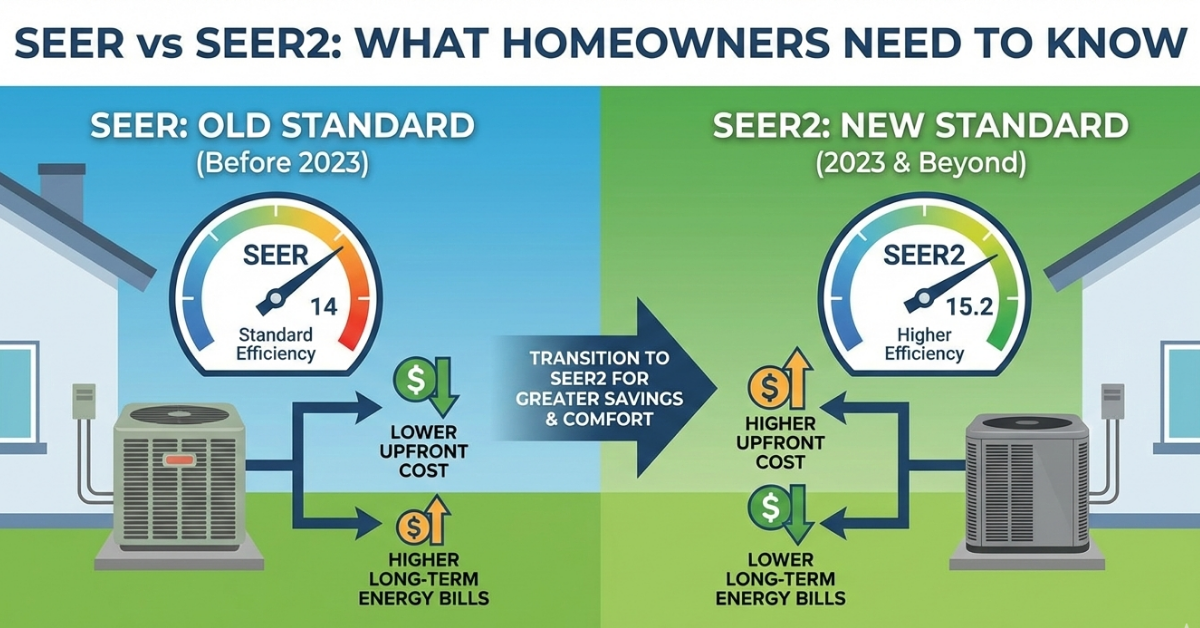
No, SEER and SEER2 are not the same, even though both measure HVAC efficiency. SEER2, introduced in January 2023, uses tougher testing conditions with higher external static pressure to better reflect real-world performance.
Basically, SEER2 uses stricter, real-world testing conditions than SEER, so its ratings are lower but more accurately reflect actual HVAC performance and energy use.


What Is SEER2 & Why Was It Introduced?
SEER2 is the new federal standard mandated by the U.S. Department of Energy (DOE). It provides a more realistic measure of efficiency by testing units under higher external static pressure. This change ensures the rating reflects how your AC performs inside your actual home, not just in a lab.
The basic formula remains the same: BTU output divided by watt-hours.
However, because the resistance is higher in the new test, the motor works harder. This typically results in a SEER2 rating that is roughly 4.5% lower than the old SEER number. It is commonly found in a central air conditioner.
Why Did SEER2 Replace SEER?
The old SEER test used 0.1 inches of water column, which was too low for most homes. The new M1 testing uses 0.5-inch tubing to simulate the resistance of real air ducts.
This five-fold increase in pressure creates a more accurate real-world efficiency rating for your family. Old SEER testing ignored duct losses. That caused inflated efficiency claims. DOE data showed real homes performed worse than labs predicted.
SEER2 fixed this gap. As someone who inspects duct systems weekly, I see why this update was necessary.
SEER vs SEER2: The Real Difference
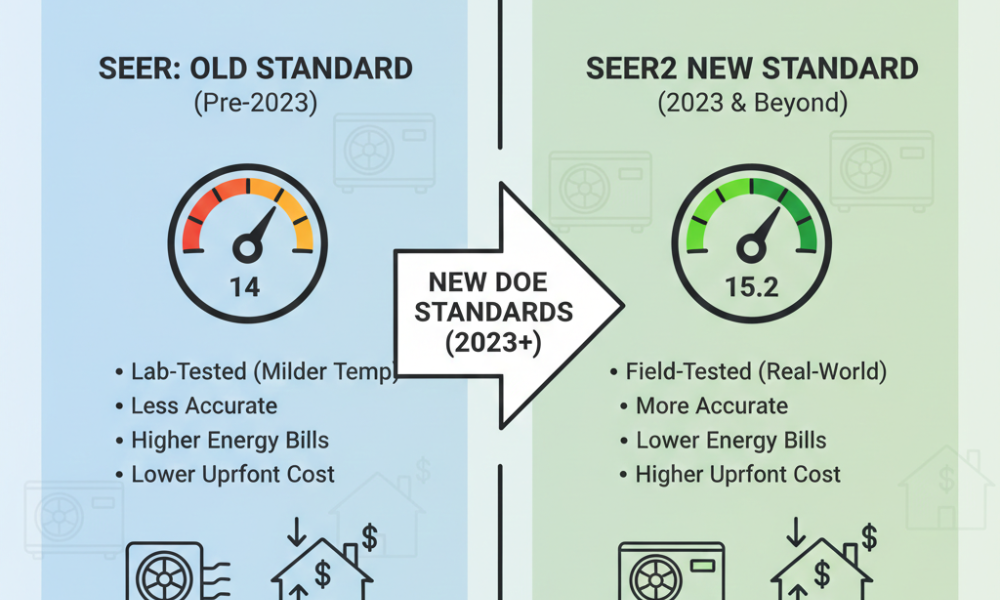
SEER and SEER2 differ mainly in how efficiency gets tested and measured.
SEER used lab conditions that didn’t fully reflect real homes, with lower airflow resistance. Systems often looked more efficient on paper than they performed in daily use.
SEER2 uses tougher, more realistic testing. It measures efficiency under higher external static pressure, which simulates real ductwork, filters, and airflow restrictions. This shows how the system actually performs once installed.
The Testing Environment: Why Static Pressure Changed
The primary difference lies in the External Static Pressure used during lab tests. SEER was tested at 0.1 inches of water column (in. WC), while SEER2 is tested at 0.5 in. WC. This reflects the real resistance of air moving through your home’s ductwork rather than a perfect lab setup
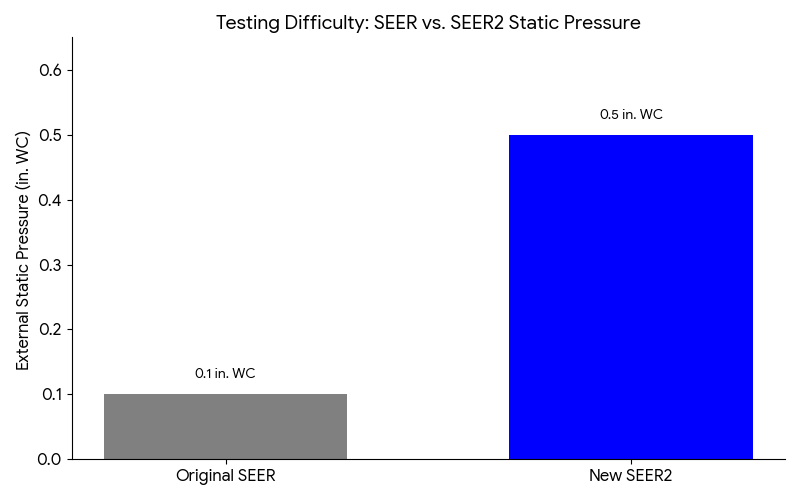
When a fan pushes against 0.5 in. WC, it uses more power than at 0.1 in. WC. Because the motor works harder to deliver the same amount of cooling, the calculated efficiency number drops. This provides a more honest look at how SEER2 performance impacts your summer bills.
The Conversion Factor: Why SEER2 Numbers Look Lower
Because the new testing protocol is harder, SEER2 ratings are consistently lower than their original SEER counterparts.
On average, you will see a 4.5% decrease in the rating number. A system that was once labelled 15 SEER is now categorised as a 14.3 SEER2 system.
Here is how they both differ-
| Feature | Original SEER | New SEER2 (M1) |
| Testing Pressure | 0.1 in. WC | 0.5 in. WC |
| Testing Protocol | M Standard | M1 Standard |
| Common Minimum | 14.0 SEER | 13.4 SEER2 |
| High Efficiency | 16.0 SEER | 15.2 SEER2 |
| Texas Mandate | Effective through 2022 | Mandatory in 2026 |
Still don’t know how it works? The chart below clearly shows how your current or planned system compares to the 2026 efficiency standards.
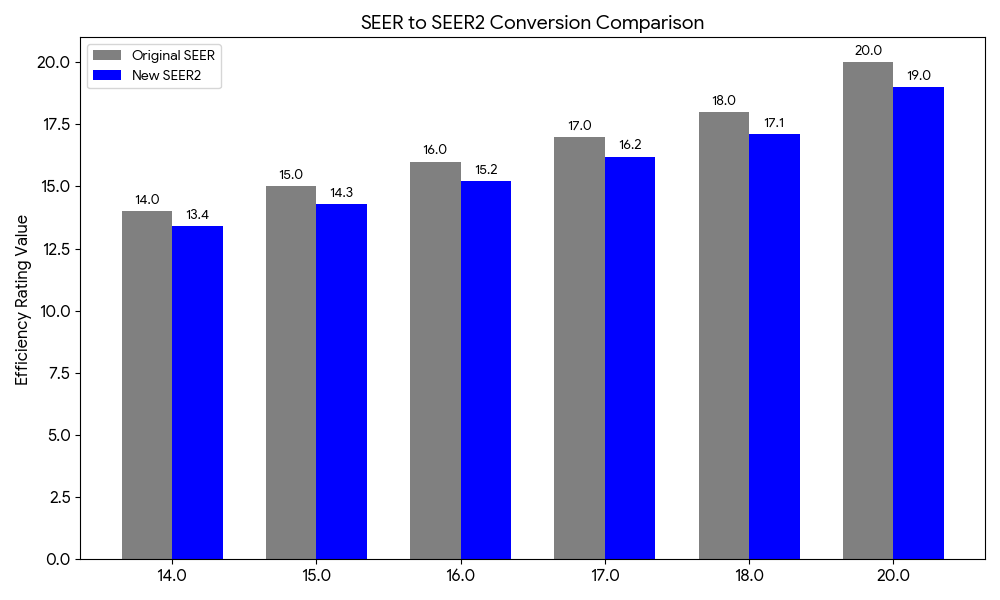
The chart below compares the numerical values of original SEER ratings (Ash) against the new SEER2 ratings (Blue). You will notice a consistent 4.5% to 5% drop across all tiers due to the increased difficulty of the new testing protocol.
A lower SEER2 number does not mean higher bills. In fact, a unit meeting the 14.3 SEER2 minimum is slightly more efficient than the old 14 SEER units. We help you find the SEER2 rating chart for Texas to ensure your system meets current energy-saving benchmarks.
Regional Compliance: Why Texas Has Stricter Rules
The U.S. Department of Energy divides the country into three regions. Texas sits in the South/Southwest region, where cooling is the priority. Unlike Northern states, we cannot install older inventory that fails to meet the 14.3 SEER2 minimum for split systems.
In the North, units are regulated by the manufacturer’s date, but in the South, they are regulated by the installation date.
This means if a unit doesn’t meet the 14.3 standard, it is illegal for us to install it in DFW today. We ensure every central air conditioner we provide is fully compliant.
EER2 vs. SEER2: Extreme Heat Performance
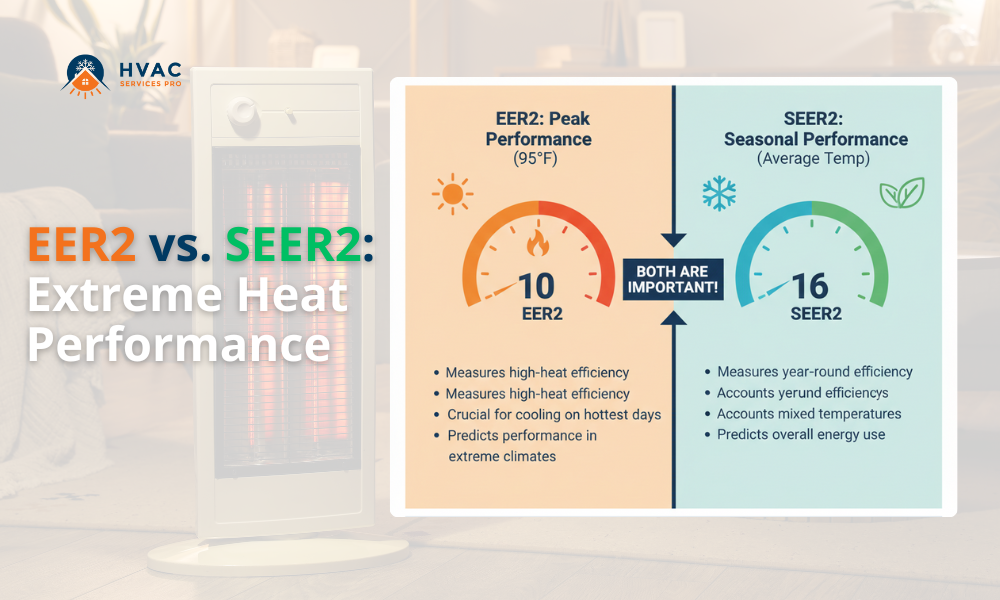
In North Texas, where afternoons hit 100°F, EER2 is vital. SEER2 measures a whole season, but EER2 specifically tests efficiency at a steady 95°F. Choosing a system with a high EER2 rating on 95°F days ensures your home stays cool during our most brutal heatwaves.


Equipment Changes: Fan Power and Blower Motors
To meet SEER2 standards, manufacturers had to upgrade their blower motors. Most new systems use high-efficiency ECM (Electronically Commutated Motors) that can maintain airflow even when your filters are slightly dirty or your ducts are restrictive. This technology is a standard feature in modern 2-ton and 3-ton AC units.
How Does New Fan Technology Benefit Your Home?
Modern blowers adjust their speed to match your home’s needs. This results in quieter operation, better humidity removal, and more consistent temperatures between rooms. It’s a key part of the Manual J checklist we use to guarantee your comfort during a Texas summer.
The Financial Impact
The shift to SEER2 hasn’t just changed ratings; it has opened new doors for savings. The Inflation Reduction Act offers substantial tax credits for systems that meet specific high-efficiency SEER2 tiers. Most DFW homeowners qualify for these when upgrading to a 15.2 SEER2 or higher model.
SEER Savings Comparison: Lowering Your Annual Costs
To help you visualise the financial impact of higher efficiency, I have created a breakdown of annual cooling costs based on typical usage for a 3-ton unit in a hot climate like North Texas. As you can see, investing in higher SEER ratings directly translates into hundreds of dollars saved every year
Let’s visualise it with a bar chart.
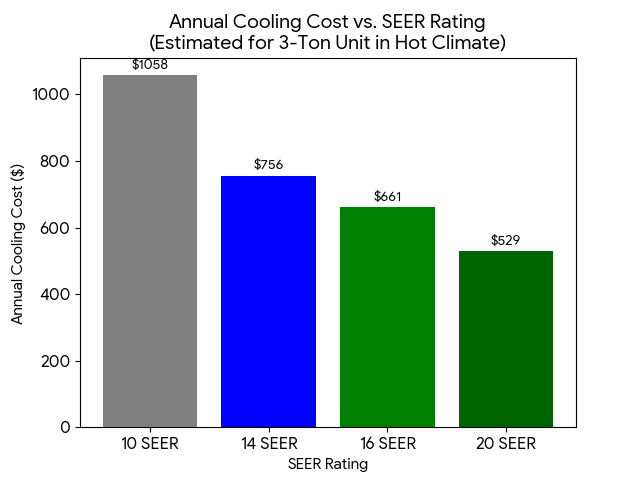
The chart highlights how your utility bills drop as you move toward ultra-high-efficiency systems. While a 20 SEER unit has the highest upfront cost, it effectively halves your cooling power consumption compared to older equipment.
SEER2 Efficiency & Savings Comparison
This table calculates potential savings relative to the SEER2 13.4 baseline (the current minimum for packaged units).
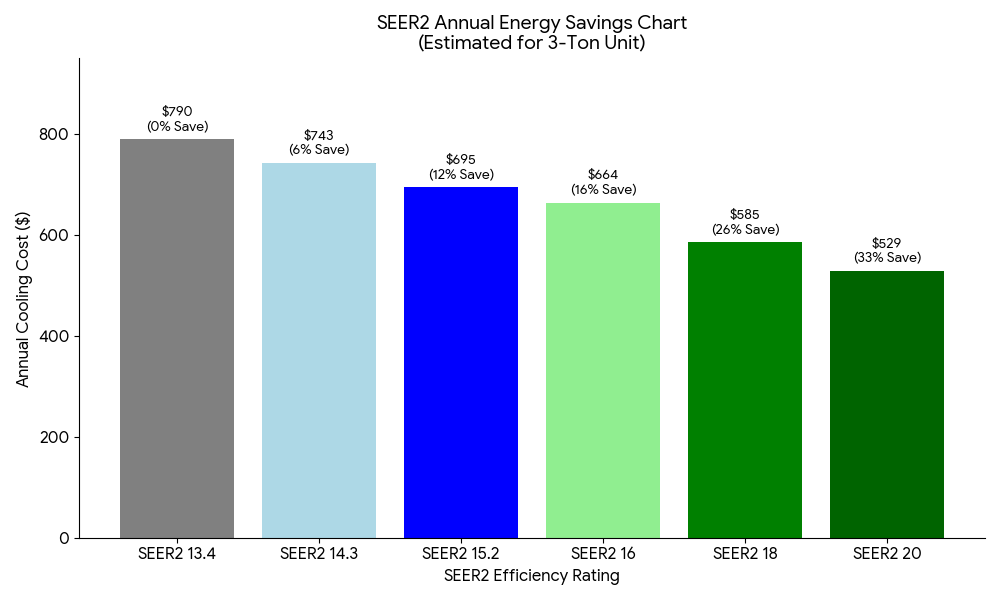
The chart below illustrates how investing in higher SEER2 ratings reduces your annual cooling costs. Notice that moving from a standard 14.3 unit to a 20.0 unit can save you an additional 27% on top of already modern standards.
You can claim up to $600 for high-efficiency air conditioners and up to $2,000 for heat pumps. That’s so affordable compared to EER2 performance.
We provide the necessary AHRI documentation to help you claim these federal incentives. Combining these credits with local utility rebates makes the mild winter comfort of a new system very affordable.

Conclusion
The shift to SEER2 is a real win for North Texas homeowners. It gives you a more honest picture of energy costs and comfort by reflecting real airflow and real Texas heat. Choose the right size, pair it with good ductwork and a solid SEER2 rating, and you’ll enjoy lower bills and reliable comfort for years.
At HVAC Services Pro, we ensure your installation meets every 2026 standard.
Frequently Asked Questions:
What is a good SEER2 rating for Texas?
A 14.3 SEER2 is the legal minimum, but a 15.2 SEER2 or higher is recommended to qualify for federal tax credits.
How do I convert SEER to SEER2?
On average, multiply the old SEER rating by 0.95 to estimate the new SEER2 value due to stricter M1 testing.
Does a higher SEER2 save me more money?
Yes, a higher SEER2 rating indicates lower watt-hour consumption, which reduces your monthly electric costs.
What is the $5,000 rule for HVAC?
If an HVAC repair costs more than $5,000 or half the price of a new SEER2-compliant system, replacement is generally the better investment.