

AFUE tells you how efficiently a furnace turns fuel into heat. In mild climates, an 80–85% AFUE furnace is usually enough and costs less, while 90–98% models use less fuel but take longer to pay off because they cost more upfront.
I often tell my clients in Dallas-Fort Worth that choosing a new gas furnace feels like picking a winter coat for North Texas. You want quality, but a heavy coat is overkill for a 50-degree morning.
We will look at how furnace design, sizing, and staging affect your bills and warmth. By the end, you will understand if a high-efficiency unit is a smart investment or if a standard model suits your North Texas lifestyle better.
| Key Takeaways
|
What AFUE Measures, and What It Does Not
The AFUE rating shows the thermal efficiency of your gas furnace over an entire heating season. It specifically tracks the ratio of heat delivered to your home compared to the fuel consumed.
Annual Fuel Utilization Efficiency provides a clear look at your system’s performance. For example, an 80% rating means 80% of the gas becomes warm, while 20% exits through the flue.
This differs from steady-state efficiency, which only measures performance when the system is already running at peak temperature. Most energy loss occurs during startup and shutdown, which AFUE accounts for.
At HVAC Service Pro, we believe in total transparency. We help you understand how these numbers impact your daily life in Dallas-Fort Worth.
When choosing the right size and efficiency for your home, you avoid energy loss and overpaying. The result is steadier comfort and lower monthly bills.


Perfect AFUE Ratings for Mild Winter Comfort
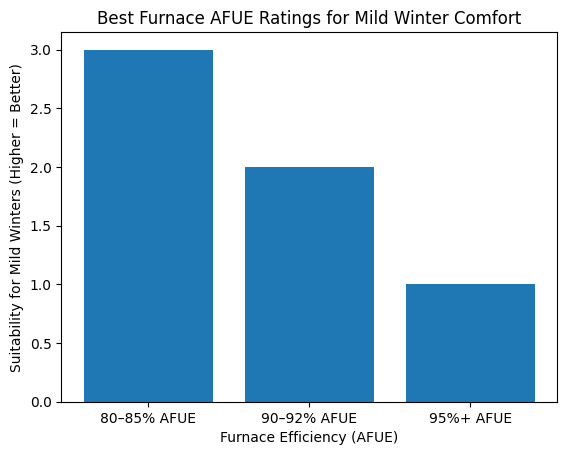
In places with mild winters, you don’t need an ultra-high-end furnace to stay comfortable. An 80–85% AFUE furnace usually makes the most sense.
It costs less upfront and still does the job on those chilly nights when the heat actually gets used. Going higher than that often means paying for efficiency you’ll rarely benefit from.
Basic rule is-
- 80–85% AFUE: The simplest and most budget-friendly option. Perfect for warmer regions where winter doesn’t last long.
- 90–92% AFUE: A nice middle option if you live in a slightly cooler or coastal area and want some extra efficiency without overspending.
Remember, 95%+ AFUE furnaces shine in cold climates, not mild ones.
In warmer areas, they can take a long time to pay off. In fact, for very mild winters, a high-efficiency heat pump can be an even smarter choice since it handles both heating and cooling.
The main point is that it’s best to stick with an 80% AFUE furnace. It keeps things warm, simple, and cost-effective for most homes in mild climates.
Hidden Efficiency Losses Most Homeowners Never Hear About
Your furnace’s AFUE rating is tested in a lab, but real-world conditions often reduce that efficiency, especially in North Texas homes. The most common issue is short cycling.
Short cycling usually happens when the furnace is oversized. It heats the home too quickly, shuts off, then turns back on again. This wastes fuel and prevents the system from running long enough to reach peak efficiency.
Here’s what causes hidden efficiency losses:
- Oversized equipment: Heats too fast and shuts off repeatedly
- Short cycling: Constant on/off operation wastes fuel
- Standby losses: Heat escapes while the system sits idle
- Flue losses: Warm air exits through the vent instead of heating your home
For homes around 1,500 square feet, a Manual J load calculation makes a big difference. It:
- Determines the correct furnace size for DFW conditions
- Allows longer, steadier run cycles
- Improves comfort and real-world efficiency
When the system matches the home, it runs the way the manufacturer intended & you avoid the hidden energy drains that quietly drive up utility bills.


Furnace Design Choices That Affect AFUE and Comfort
Modern furnace engineering offers 2 main paths for DFW homeowners-
- Induced-Draft
- Sealed-Combustion.
A condensing furnace with an AFUE rating of 90% or higher uses a secondary heat exchanger. This part captures extra heat from the exhaust gases that standard units simply vent away.
Because the exhaust is cooler, these systems require PVC venting rather than a traditional metal flue.
In tight, modern North Texas homes, sealed combustion is a safety win because it pulls in outside air, keeping your indoor air stable and safe.
Our technicians at HVAC Service Pro stay up to date on the latest furnace efficiency technology. We guarantee that your installation complies with all safety standards.
Venting, Drains, and Installation Realities of High-Efficiency Furnaces
Upgrading to a high-efficiency gas furnace involves more than just swapping a box. It requires new infrastructure to handle condensation.
A 90 plus AFUE system creates moisture as it cools the exhaust. This requires a condensate drain to safely remove water from your attic or closet.
You must also install PVC venting because the cool exhaust will ruin an existing brick or metal flue.
Knowing when a 2 ton or 3 ton AC is the right fit for a typical DFW home is crucial. It lets you plan for venting and drainage needs during a full system upgrade.
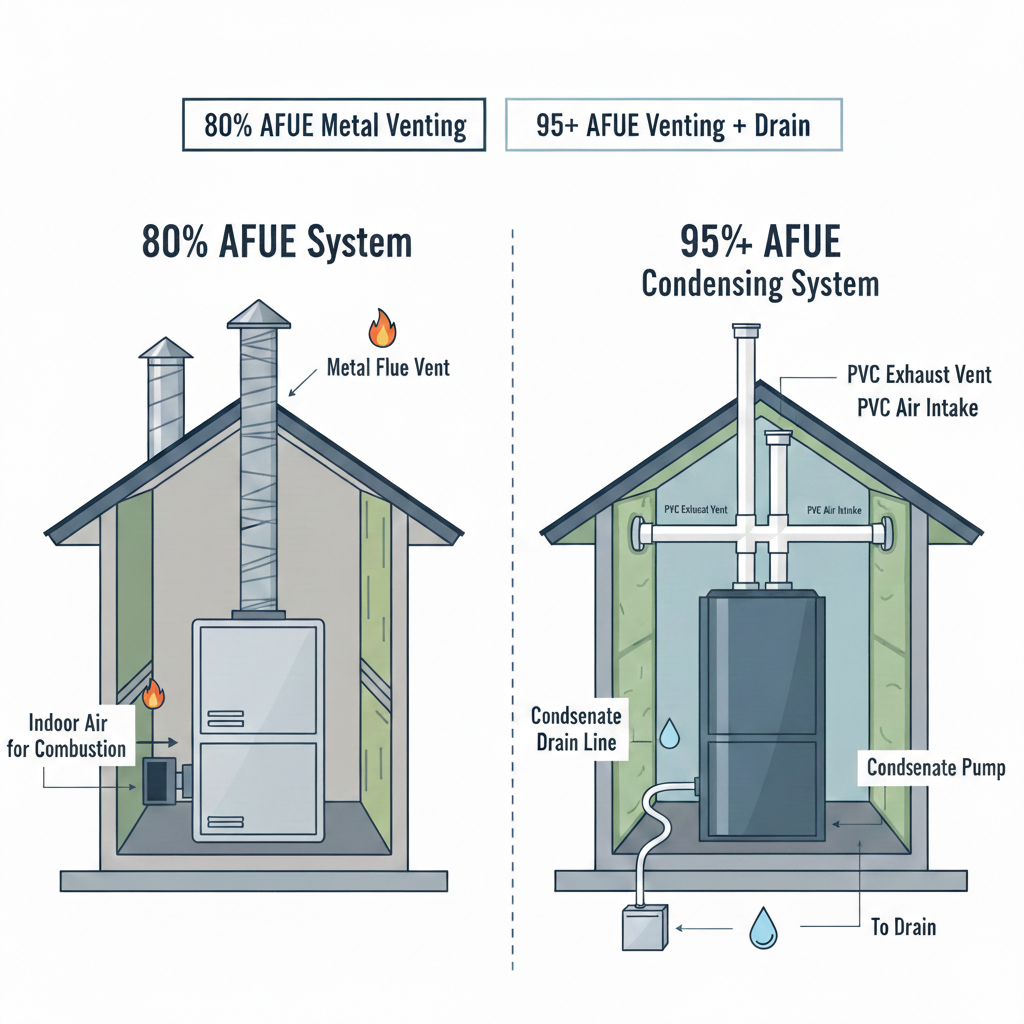
HVAC Service Pro manages every detail of these complex PVC installations so you can relax. We handle the pipes and the pumps for the drain while you enjoy the warmth.
Combustion Air and Why It Matters More Than AFUE
The way your gas furnace breathes affects your mild winter comfort and your utility bill. Intake basics are often the difference between a drafty house and a cozy one.
Standard furnaces pull “combustion air” from inside your home. This creates a vacuum that sucks cold North Texas air through indoor air leaks in your windows and doors.
Sealed combustion units avoid this issue by using a dedicated pipe for outside air. This keeps your heated air inside where it belongs.
Proper air sealing combined with the right furnace choice makes a massive difference in Dallas-Fort Worth.
We focus on the science of airflow at HVAC Service Pro. We look for ways to keep your home sealed and comfortable all year long.

AFUE vs Comfort: Why Staging Often Matters More in Mild Winters
In the Dallas-Fort Worth area, we often have “shoulder season” days when it is 55 degrees outside. A single-stage gas furnace typically delivers a more sudden surge of heat than a two-stage furnace.
A two-stage or modulating furnace provides much better mild-winter comfort. These units can run at a lower capacity on milder days. Staging prevents short cycling during mild 50°F Dallas mornings, reducing temperature swings.
The same principle applies to summer efficiency. Properly sized systems with higher SEER2 ratings perform best when their output matches real cooling demand. They cool steadily instead of blasting at full power all the time.
Does Furnace Sizing Matter More Than AFUE in Texas
Yes, furnace sizing matters along with your AFUE rating. I have seen many people buy the highest AFUE rating available, only to be disappointed because the unit was too large. Oversizing is a common mistake in the DFW region.
A Manual J sizing calculation is the only way to ensure your gas furnace fits your home’s heat load.
A smaller, properly sized 80% unit often provides better mild winter comfort and lower bills than a massive 96% unit that only runs for five minutes.
At HVAC Service Pro, we perform full load calculations for every installation to ensure peak performance.
80 AFUE vs 90 vs 95: What Actually Makes Sense in DFW
Choosing between 80 AFUE and 95 AFUE comes down to your payback period and long-term goals in North Texas, like SEER vs SEER2.
| Feature | 80% AFUE (Standard) | 95% AFUE (High-Efficiency) | 97%+ AFUE (Ultra-Efficiency) |
| Estimated Net Cost | $4,300 (avg) | $5,700 (avg) | $7,200 (avg) |
| Annual Gas Savings | $0 (Baseline) | $120 – $150 | $150 – $180 |
| Simple Payback | N/A | 10 – 12 Years | 15+ Years |
Because our winters are short, the ROI calculation for a 95% unit takes about a decade. If you plan to move soon, 80% is often the wisest financial choice.
However, if you want the quietest operation, the high-efficiency models win. HVAC Service Pro helps you run the numbers based on your specific home and future plans.
AFUE and Fuel Costs in DFW
Your gas bill in Dallas-Fort Worth is usually lower than your electric bill, but utility rates are rising. Efficient heating helps you stay ahead of these costs.
A higher AFUE rating lowers the usage portion of your bill. The ROI calculation must also account for the higher upfront cost of PVC venting and condensate drains.
For many DFW homeowners, the savings are modest, roughly 15% on the heating portion of the bill.
It helps to estimate EER2 performance for those hot afternoons, since cooling eats up most of the budget in Texas. Every ounce of efficiency adds up, though.
How to Find the AFUE Rating on Your Furnace
If you want to know your current furnace efficiency, the information is probably readily available.
- You can usually find the AFUE rating on the bright yellow EnergyGuide label on the unit’s side.
- If that is missing, find the model number on the manufacturer’s plate inside the cabinet.
Here is an AFUE rating chart for homeowners:
| AFUE Rating | Category | Description | Efficiency Notes |
| 78-83% | Standard/Mid | Basic non-condensing units that vent hot gases through a chimney. They work fine but waste more fuel. | Minimum for many new furnaces; expect 80% as a baseline for gas models. |
| 90-95% | High-Efficiency | Condensing models that capture extra heat from exhaust, using PVC vents. They cut bills in cold spots. | Great for most homes; Energy Star requires 90%+ in the warmer U.S. South and 95%+ in the North. |
| 96-98%+ | Premium/Ultra | Top-tier condensing with variable speeds for super steady heat and quiet runs. | Best for big savings over time, but pricier upfront; hits up to 99% in some certified units. |
What AFUE Rating Should You Buy for Texas Winters
In Texas, a furnace rated 90% AFUE or higher offers a better balance of efficiency, comfort, and lower energy bills. It works especially in areas that see freezing temperatures.
However, the “best” AFUE rating depends on your specific house and how long you plan to live in North Texas.
- Choose 80% AFUE for: Houses with traditional metal flue venting, short-term residency (under 10 years), or budget-focused replacements. That also gives better performance than EER2 performance.
- Choose 95%+ AFUE for: Long-term “forever” homes, sealed combustion safety needs, or homes in Dallas-Fort Worth with encapsulated attics.
Sometimes, upgrading the staging of an 80% furnace provides more mild winter comfort than just chasing a higher percentage. At HVAC Service Pro, we guide you toward the choice that brings the most value to your specific life.
Conclusion
Choosing the right AFUE rating for your gas furnace in North Texas involves balancing several factors. While Annual Fuel Utilization Efficiency is a vital metric, it works alongside proper sizing, staging, and ductwork to create mild winter comfort.
High-efficiency units offer sealed combustion safety and long-term savings, while standard units offer a lower upfront cost that makes sense for many DFW homeowners.
HVAC Service Pro is here to help you make these choices with honesty and expert local knowledge. We keep your Dallas-Fort Worth home warm during every cold snap and transitional morning.
Frequently Asked Questions
Does the 2025 Federal Tax Credit cover the installation labor for a high-efficiency furnace?
Yes, the Section 25C tax credit allows you to claim 30% of the total project cost. It includes labor, up to a maximum of $600 for furnaces. This allows meeting the highest CEE tier (usually 97% AFUE).
Can I paint the PVC vent pipes on the side of my house to match my siding?
Yes, but you must use a UV-resistant, plastic-safe paint. Also, ensure you do not block the intake or exhaust openings. Blocked exhaust can cause the furnace to shut down.
Are high-AFUE furnaces quieter than standard 80% models?
Usually, yes. Because high-AFUE units often include variable-speed blowers and insulated cabinets. They build up slowly and operate at lower decibel levels than single-stage 80% units.
If I have a 95% AFUE furnace in my attic, do I need to worry about the drain line freezing?
In North Texas, yes. During a “deep freeze,” an uninsulated condensate drain in a vented attic can freeze. It’s causing the furnace to shut off. Technicians often install heat tape or insulation on these lines to protect them.
Can I keep my old thermostat when upgrading to a modulating high-efficiency furnace?
To get the full comfort benefits of a modulating gas valve, you need a proprietary “communicating” thermostat. This thermostat should be able to precisely signal the furnace how much heat is required.
Will a high-AFUE furnace improve my indoor air quality? High-efficiency units use sealed combustion. They don’t pull dusty or humid air from your attic or crawlspace into the burner. This keeps your indoor air cleaner.