

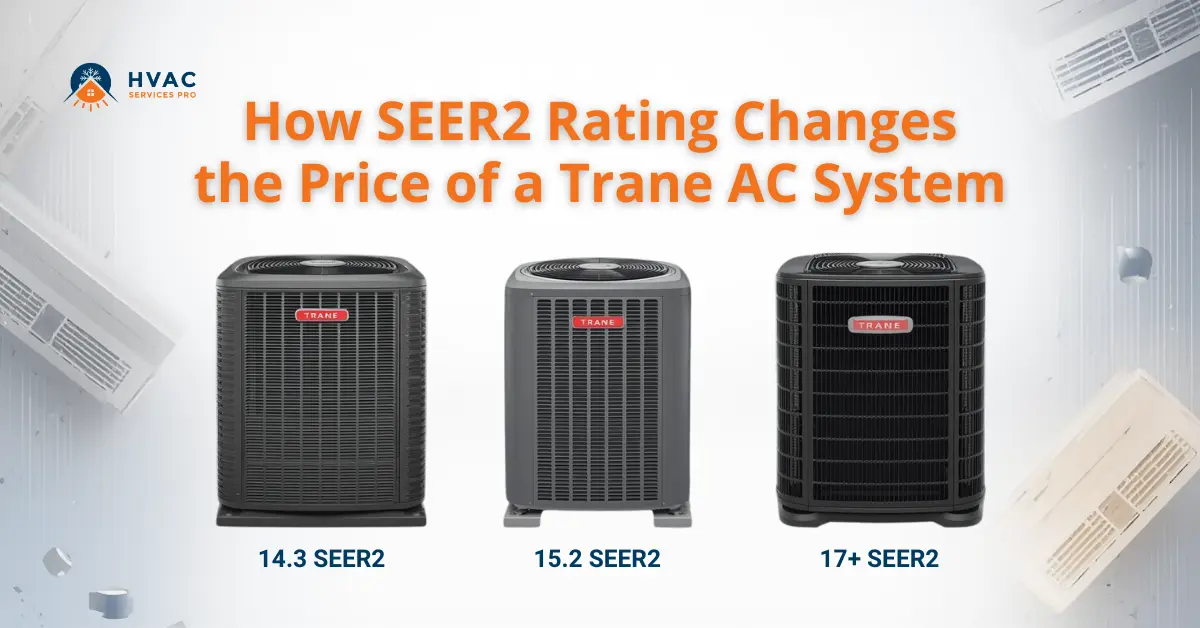
The Trane SEER2 rating price difference typically ranges from $1,500 to $4,500 between entry-level 14.3 models and premium 17+ units. While a 14.3 SEER2 system costs less upfront, a 17+ SEER2 unit offers higher energy savings and better humidity control. Your total cost depends on the unit efficiency, system tonnage, and installation complexity.
Last summer, I helped a homeowner in Dallas named Sarah. She felt torn between a budget-friendly Trane XR14 and the high-end XV18. Sarah wanted lower bills but had a strict budget. We sat down and looked at the long-term math.
She saved $400 in her first year just by choosing the right efficiency tier. This guide shares those same professional insights with you.
| TL;DR: Trane AC prices rise with the SEER2 rating because higher-efficiency units use larger coils, variable-speed compressors, and upgraded components. The 14.3 SEER2 is the most budget-friendly, but it handles humidity and noise less effectively. The 15.2 SEER2 offers a good balance of comfort, quietness, and energy savings. The 17+ SEER2 delivers top efficiency and excellent humidity control. |
Why The SEER2 Rating Affects Ac Price In 2026?
Higher SEER2 ratings require more expensive components. To reach 17+ SEER2, Trane uses larger coils and advanced compressors. These parts cost more to manufacture. This creates a Trane high-efficiency AC price premium for top-tier models.
Rather than those, here is what causes a higher upfront cost:
- Larger coils that improve heat transfer and boost efficiency
- Variable-speed or inverter compressors that adjust output instead of running at full blast
- Enhanced control boards and smart thermostatic compatibility
- Heavier-duty internal components designed for long-term reliability
On top of that, the R-32 refrigerant transition is also influencing 2026 pricing. That’s the main reason for the trane price being frustrated. Manufacturers have redesigned systems to safely handle these newer, lower-GWP (Global Warming Potential) refrigerants.
That means:
- Updated compressor designs
- Reinforced refrigerant lines and valves
- New safety standards and compliance testing
- Re-engineered system architecture to meet federal environmental regulations
All of these engineering upgrades help your system meet modern efficiency and environmental goals. But newer technology almost always costs more than older, pre-transition inventory. That’s why you see the Trane AC operating cost vs Lennox cost difference.


Trane SEER2 Efficiency Tiers Explained (14.3 vs 15.2 vs 17+)
Trane organizes its air conditioners into three main SEER2 efficiency tiers: 14.3, 15.2, and 17+. The 14.3 tier is the most affordable, while the 17+ tier offers maximum savings. Each tier uses different compressor technology to manage your indoor temperature and electricity use.
Trane 14.3 SEER2 – Entry-Level Efficiency Tier
This is the cheapest Trane SEER2 rating available today. These units typically use a single-stage compressor. A single-stage motor is either 100% on or completely off. It works like a light switch for your cooling.
The Trane 14.3 SEER2 unit-only price is very competitive. You might find a Trane 14.3 SEER2 condenser priced and shipped at a reasonable rate if buying online.
However, we recommend getting a professional Trane AC installation service quote. A professional setup ensures the warranty remains valid.
Trane 15.2 SEER2 – Mid-Tier Performance & Value

Many homeowners ask: Does 15.2 SEER2 cost more than 14.3 Trane? The answer is yes, usually by about $800 to $1,200. This tier often features a two-stage compressor. It can run at a lower speed when the weather is mild.
The Trane 15.2 SEER2 installed price offers a great balance of cost and comfort. Because it has a low setting, it removes more humidity than basic models. We often have the Trane 15.2 SEER2 condenser in stock for quick replacements. It is our most popular mid-range option.
Trane 17+ SEER2 – High-Efficiency & Premium Comfort
If you want the best, look at the 17+ tier. These systems use a variable speed compressor or an inverter compressor. These motors can adjust their speed in 1% increments. This technology significantly reduces your electricity consumption.
TheTrane 17+ SEER2 installed price is the highest in the lineup. You are paying a Trane high efficiency AC price premium for whisper-quiet operation. The Trane 17+ SEER2 unit-only price reflects the complex electronics inside. It is a true investment in your home’s long-term value.
Trane AC System Price by SEER2 (Unit-Only vs Installed Cost)
On average, a Trane 14.3 SEER2 installed price starts around $6,500, while a Trane 15.2 SEER2 installed price typically sits between $8,000 and $10,000. For premium Trane 17+ SEER2 installed prices, homeowners should budget $12,000 to $18,000 depending on tonnage and system complexity.


Trane 14.3 vs 15.2 SEER2 Cost Breakdown
Choosing between these two tiers often comes down to your budget. The Trane SEER2 upgrade cost from 14.3 to 15.2 is usually about $1,200 to $1,800. This increase pays for the jump from a single-stage to a two-stage compressor.
We see an AC efficiency price increase per SEER2 point of roughly 10% to 15% in initial costs. While 14.3 is the baseline, the 15.2 tier offers a noticeable improvement in quietness. We find that the extra $1,500 upfront often feels worth it during the first humid week of July.
Trane 15.2 vs 17+ SEER2 Price Comparison
The gap between mid-tier and high-tier is much larger. The Trane SEER2 upgrade cost from 15.2 to 17+ can exceed $4,000 for a standard home. This price reflects the shift to fully variable-speed TruComfort technology.
This premium tier includes more than just the outdoor unit. You are often paying for a matching high-performance indoor air handler. This ensures your AHRI matched Trane system price reflects the maximum possible efficiency. Most of our clients see this as a long-term forever home investment.
Trane SEER2 Price by Tonnage & BTU
Your Trane SEER2 price by tonnage increases by approximately $500 to $1,000 for every additional 12,000 BTU (1 ton) of cooling capacity. A larger 5-ton system requires more refrigerant and larger heat exchange coils than a 2-ton unit, raising both the unit and labor costs.
Trane Estimated Installed Prices by Tonnage (2026 Estimates)
| Tonnage (BTU) | 14.3 SEER2 (Entry) | 15.2 SEER2 (Mid) | 17+ SEER2 (High) |
| 2 Ton (24k BTU) | $6,400 – $7,800 | $7,900 – $9,400 | $11,500 – $13,500 |
| 3 Ton (36k BTU) | $7,200 – $8,900 | $8,800 – $10,500 | $12,800 – $15,200 |
| 4 Ton (48k BTU) | $8,100 – $9,800 | $9,700 – $11,800 | $14,200 – $17,000 |
| 5 Ton (60k BTU) | $9,000 – $11,200 | $10,800 – $13,500 | $15,800 – $19,500 |
Data based on 2026 industry averages for full system replacement. Actual quotes vary by region and ductwork needs.
The Trane 14.3 SEER2 system price 2 ton is the most common quote for smaller condos. For a medium family home, the Trane 15.2 SEER2 system price 3 ton is our sweet spot for value. Large luxury homes often require the Trane 17+ SEER2 system price 4 ton or higher for multi-zone comfort.
Trane Condenser Price by SEER2 vs Matched System Price
A common mistake is looking only at the Trane condenser price by SEER2. The outdoor unit is just half of the equation. A Trane matched system price by SEER2 includes the indoor evaporator coil and the blower motor.
If you don’t match the units, you won’t hit the SEER2 rating on the box. We always provide an AHRI matched Trane system price to guarantee your energy savings. Replacing only the condenser might save $3,000 now, but it will cost you thousands in lost efficiency later.
Operating Cost vs Upfront Cost – Is 17+ SEER2 Worth It?
A 17+ SEER2 system is “worth it” if you plan to live in your home for 8 to 10 years or in a very hot climate. While the upfront cost is higher, the energy savings and reduced wear and tear on the system lower the total cost of ownership over time.
Trane Energy Savings vs Price Increase
The Trane 14.3 SEER2 vs 17+ SEER2 energy savings estimate shows a reduction in cooling bills of about 25% to 35%. If your summer bill is $300, a high-efficiency unit could save you $100 every month. Over a 15-year lifespan, this totals $9,000 to $12,000 in savings.
You can ask yourself: how much can I save with 17+ SEER2 vs 14.3?
The answer depends on your local electricity rates. In states like California or New York, the higher upfront cost pays back much faster than in states with cheap power. We calculate this “break-even” point for every installation just like that we can even help you to decide among Trane XR vs XL vs XV Series.
Trane AC ROI by SEER2 & Payback Period
The Trane AC payback period by SEER2 is usually the most important factor for homeowners. A 15.2 SEER2 unit often pays for its price premium in 4 to 6 years. A 17+ SEER2 unit may take 8 to 12 years to break even on energy alone.
However, you must consider the Trane 15.2 SEER2 vs 17+ SEER2 total cost of ownership. High-efficiency units often have fewer mechanical breakdowns because they don’t cycle on and off as much. This hidden saving on repairs makes the ROI even better. We find that comfort improvements often outweigh the simple math.
Higher SEER2 AC Worth It Cost Analysis
We believe a Higher SEER2 AC is worth it if you prioritize indoor air quality and silence. The variable-speed motors in 17+ units run constantly at low power. This filters your air more often and keeps the house at a perfect temperature.
If you only use your AC for two months a year, stick with the 14.3 rating.
The energy savings won’t justify the $5,000 price jump. But for residents in the Sun Belt, the high-efficiency models are almost always the better financial move.

Comfort, Humidity Control & Noise – What You’re Paying For
When you pay more for a higher SEER2 rating, you are buying precision and silence. Lower SEER2 units (14.3) use single-stage technology that creates temperature swings and higher noise. Higher tiers (17+) use variable speed compressors to maintain a constant temperature within 1 degree and operate at nearly 50% lower noise levels.
Does Variable Speed Increase SEER2 and Price on Trane?
A variable speed compressor is the main reason for the 17+ SEER2 rating. Unlike a basic unit that is “all on” or “all off,” variable speed adjusts like a dimmer switch. This technology allows the system to run at 25% to 100% capacity.
The Trane variable-speed vs. two-stage price difference for SEER2 is usually $2,500 to $4,000. You might consider the Trane inverter vs non-inverter cost SEER2 gap significant. However, the inverter (variable speed) model eliminates the loud clunk of the AC starting up. We find that homeowners in quiet neighborhoods prioritize this feature highly.
Trane 17+ SEER2 Noise Level vs Price
Noise is a major factor in the Trane high efficiency AC price premium. Standard 14.3 SEER2 units often produce 72–76 decibels. For comparison, the Trane XV18 and XV20i models operate as low as 55 decibels. This is roughly the sound of a quiet conversation.
Paying the extra cost for a 17+ SEER2 unit often moves the noise away from your patio. If your outdoor unit sits near a bedroom window, the quiet operation is worth every penny. We often see homeowners choose the XV series specifically to enjoy their backyards without a loud fan running nearby.
Which Trane SEER2 Rating Is Best for Humidity Control?
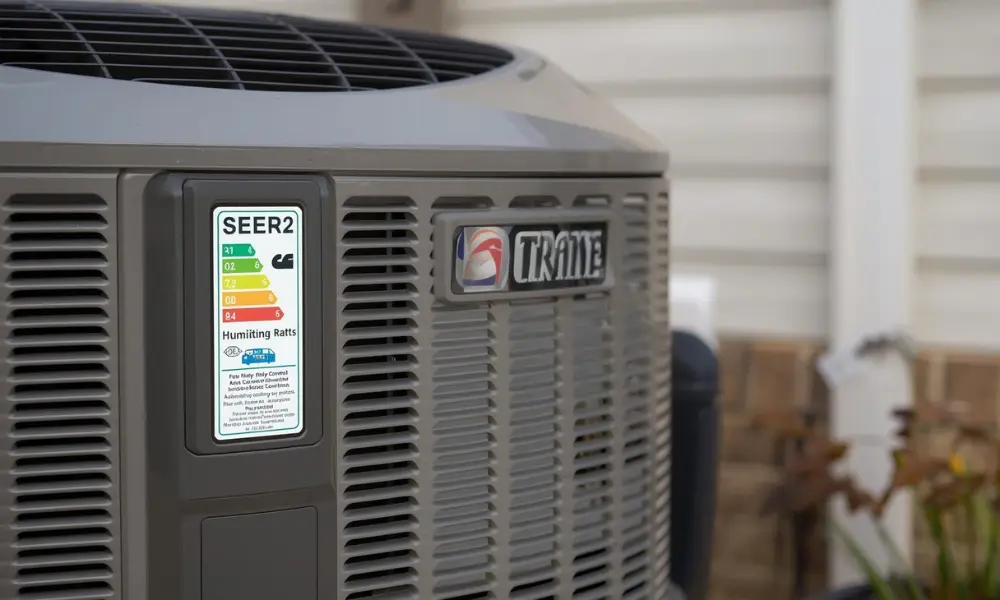
The Trane 17+ SEER2 humidity control vs price tradeoff is vital for comfort. High-efficiency units run longer cycles at lower speeds. These long cycles pull more moisture out of the air. A single-stage 14.3 unit often shuts off before it can properly dehumidify your home.
We recommend at least a 15.2 SEER2 (two-stage) for muggy climates. However, the 17+ variable speed models can remove up to 30% more humidity. This allows you to set your thermostat 2 degrees higher and still feel cool. This behavior saves even more on your monthly bills.
Wrap Up
At the end of the day, choosing the right Trane SEER2 rating comes down to how long you’re staying in the home and how much comfort you want. If you’re on a tight budget or moving soon, 14.3 SEER2 gets the job done.
Want better comfort without overspending?
15.2 SEER2 is the sweet spot. Planning to stay long-term in a hot climate? 17+ SEER2 delivers the best performance, efficiency, and quiet operation.
Just remember: always get a properly matched AHRI system. Even the best condenser won’t perform right if it’s paired with an outdated indoor coil.
Frequently Asked Questions (FAQ)
What is the cheapest Trane SEER2 rating available?
The 14.3 SEER2 is currently the entry-level efficiency tier for Trane. It replaces the old 14 and 15 SEER standards. It is the most affordable way to get Trane’s famous reliability into your home.
Will my R-410A air conditioner become illegal in 2026?
No, it is not illegal to own or operate an R-410A system. However, manufacturers have shifted to new refrigerants like R-32 for all new equipment. You can still get your old unit repaired, but refrigerant costs may rise over time.
How much can I save with 17+ SEER2 vs 14.3?
You can typically save 20% to 35% on your annual cooling costs. In a hot climate with a $2,000 annual cooling bill, this represents a saving of $400 to $700 every single year.
What size Trane AC do I need for my square footage?
A general rule is 1 ton of cooling for every 500 to 600 square feet. However, a “Manual J” load calculation is the only way to be sure. This test accounts for your windows, insulation, and local climate.
Does a higher SEER2 unit increase my home’s resale value?
Yes, a high-efficiency HVAC system is a major selling point. Potential buyers appreciate knowing they will have lower utility bills. It also shows that you have maintained the home with high-quality, modern upgrades.