

When your cooling system struggles against a Texas summer heatwave, the pressure to make a quick decision can be overwhelming. Homeowners in DFW are often caught in a bind: stick with a traditional AC unit or upgrade to a modern heat pump?
With the introduction of the strict 2025 Texas SEER2 Standards, this decision now involves more than just upfront costs. It’s about securing energy efficiency, navigating lead times, and ensuring a quality installation that won’t leave you sweating.
In this guide, we break down the real-world cost of replacement in the Dallas-Fort Worth area, explain why SEER2 matters for your wallet, and provide a transparent, step-by-step installation day guide. Whether you’re in Plano, Arlington, or downtown Dallas, knowing what to expect can save you thousands on energy bills and protect you from faulty work.
Key Takeaways
|
AC vs. Heat Pump in DFW: The Climate & Efficiency Debate
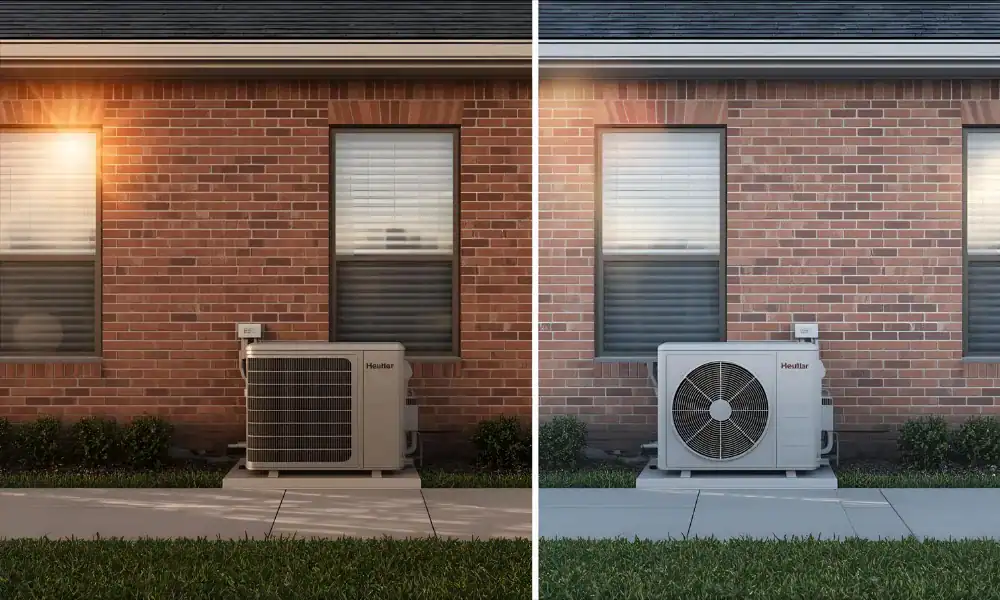
For decades, the standard setup in DFW has been a central AC unit paired with a gas furnace. However, the tide is turning. Heat pumps are gaining massive traction across North Texas and the Southern Region due to their ability to handle both heating and cooling with superior energy efficiency.
The Impact of Texas SEER2 Standards (14.3 SEER2 Minimum)
If you purchased an HVAC before 2023, there are some SEER2 changes you should be aware of.
The Department of Energy (DOE) implemented new testing procedures that more accurately reflect real-world conditions. For Texas and the rest of the Southern Region, the new minimum standard is 14.3 SEER2 (equivalent to the old 15 SEER).
- AC Compliance: Any AC unit installed in DFW must meet this minimum. Non-compliant units are illegal to install, meaning “clearance” deals on old inventory are likely scams or code violations.
- Heat Pump Advantage: Heat pumps naturally tend to have high efficiency ratings. A 15 SEER2 or higher unit not only meets the code but positions you for significantly lower utility bills.
Beyond Cooling: Heating Efficiency (HSPF2)
While cooling is the priority in Texas, our winters can be surprisingly biting. A heat pump uses a Reversing Valve to switch modes, extracting heat from the outdoor air even in cold temperatures. The HSPF2 (Heating Seasonal Performance Factor 2) rating measures this efficiency.
Unlike electric resistance heat strips (which are expensive to run), a high-HSPF2 heat pump can keep your DFW home warm for a fraction of the cost of electric furnaces and is often competitive with natural gas, especially when paired with Oncor Rebates and federal incentives.
The True Cost of Installation: Why DFW Prices Vary Wildly
One of the most frustrating parts of HVAC replacement is the price variance. You might get a quote for $7,000 and another for $16,000 for what looks like the same Tonnage. The true breakdown of HVAC installation cost in DFW comes from its size and some hidden costs.
Average DFW AC/Heat Pump Cost by Tonnage (3-Ton, 4-Ton)
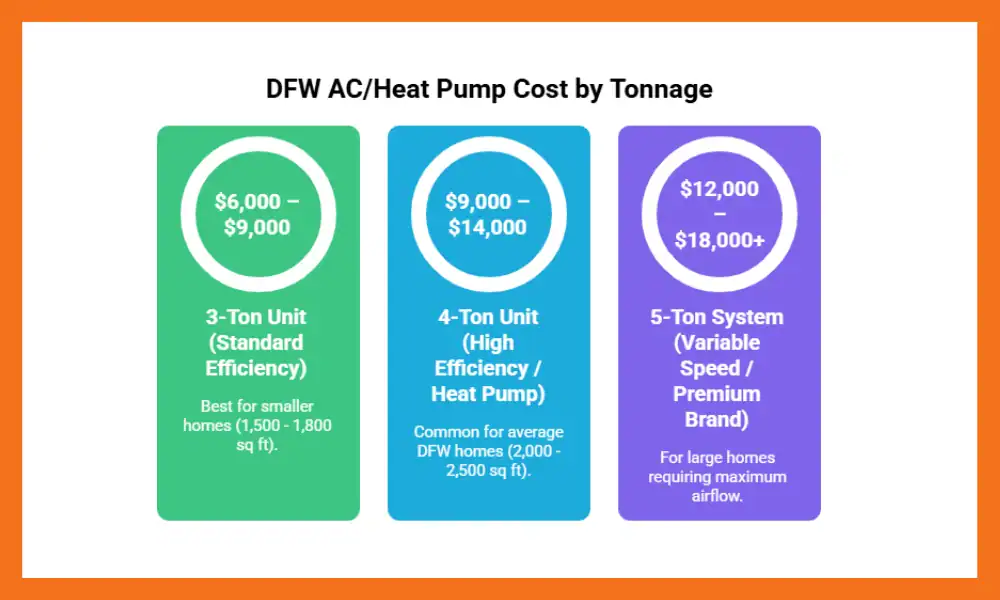
Costs are heavily influenced by Tonnage, SEER2 rating, and whether you are installing a straight AC or a heat pump.
- 3-Ton Unit (Standard Efficiency):$6,000 – $9,000
- Best for smaller homes (1,500 – 1,800 sq ft).
- 4-Ton Unit (High Efficiency / Heat Pump):$9,000 – $14,000
- Common for average DFW homes (2,000 – 2,500 sq ft).
- 5-Ton System (Variable Speed / Premium Brand):$12,000 – $18,000+
- For large homes requiring maximum airflow and humidity control.
Note: These ranges include installation, labor, and permitting, but exclude major ductwork repairs.
Critical Factor: Tonnage and the Manual J Load Calculation
Never assume you simply replace a 4-ton unit with another 4-ton unit. What really drives your installation cost is primarily sizing. However, energy improvements like new windows or added insulation change your home’s load calculation.
A professional HVAC contractor must perform a Manual J Load Calculation to determine the exact sizing required.
- Undersized: Runs constantly, fails to cool in July/August.
- Oversized: Short-cycles, fails to remove humidity, leads to early compressor failure.
The Hidden Costs: Ductwork Integrity, Electrical Upgrades, and Permits
The “low bidder” often skips these crucial items to show a cheaper sticker price:
- Ductwork: Leaky ductwork can waste 30% of your air. Sealing or replacing ducts typically adds $1,500 – $4,000 to the job but is essential for energy efficiency.
- Electrical Panel: New high-efficiency heat pumps might require a different circuit breaker size or a new electrical whip, adding $200 – $500.
- Permitting: AC installation permit requirements in DFW cost $200 – $500. Skipping this risks fines and issues when selling your home.
Quality vs. The Low Bidder: Protecting Your DFW Investment
In the HVAC industry, the “AC installation is more important than the brand” adage is true. A top-tier Trane or Lennox system installed poorly will perform worse than a budget Goodman installed perfectly.
The Dangers of Poor Installation (Air Leaks, Wrong Duct Sizing)
Homeowners commonly suffer from respiratory issues because a contractor used duct tape instead of mastic sealant, drawing in fiberglass and attic dust.
- The “Chuck in a Truck” Risk: Unlicensed installers often skip the Manual J, guess on sizing, and fail to pull a permit.
- Consequences: High humidity, hot spots in upstairs rooms, and voided warranties.
Ensuring Quality: Permits, Inspections, and Contractor Vetting
Always demand proof of a City Permit. This triggers a third-party inspection by the city to ensure code compliance.
Vetting Checklist:
- Are they licensed in Texas (TDLR)?
- Do they offer a labor Warranty (typically 1-2 years)?
- Will they perform a Manual J?
- Do they register the equipment Warranty for you?
Maximizing Savings: DFW Rebates, Tax Credits, and Long-Term Value
While the upfront cost is significant, DFW homeowners have access to powerful financial tools to offset the price tag.

Maximizing Oncor Energy Efficiency Rebates for DFW Homeowners
If you live in the Oncor service area (most of Dallas, Fort Worth, and surrounding suburbs), you are likely eligible for energy efficiency rebates.
- How it Works: You must use an approved service provider (participating contractor). The rebate is often instant or credited on your invoice.
- Value: Incentives can range from $300 to over $3,000, depending on the SEER2 and Tonnage of the new system.
The Inflation Reduction Act (IRA) and the $2,000 Heat Pump Tax Credit
The federal government wants you to install a heat pump.
- The Credit: Under Section 25C, you can claim 30% of the project cost, up to $2,000, as a tax credit.
- Eligibility: The heat pump must meet specific efficiency criteria (typically 15.2 SEER2 and 7.8 HSPF2 or higher for the South). Ask your HVAC contractor for an AHRI certificate to prove eligibility.
Cost-Benefit Analysis: Upfront Price vs. Long-Term Energy Efficiency Savings
A 16 SEER2 heat pump might cost $2,500 more upfront than a basic 14.3 SEER2 AC. However, with Oncor Rebates and the $2,000 Tax Credit, that gap often disappears.
Result: You get a superior system for roughly the same net cost, enjoying lower utility bills for the next 15 years.
The Install Day Guide: DFW Lead Times and Step-by-Step Process
Knowing what happens on the day of installation reduces anxiety and helps you prepare your home. For a deeper breakdown, you can also review our HVAC installation day timeline tailored to DFW homes.
Realistic DFW Lead Times (Quote to Install)
Lead times in DFW fluctuate wildly based on the weather.
- Shoulder Season (Oct-March): 24-48 hours. Crews are available, and you can often negotiate better pricing.
- Peak Summer (June-Sept): 2 to 10 days. When temperatures hit 105°F, everyone calls at once.
Pro Tip: If you are replacing a system preemptively, schedule it in the spring to avoid the rush.
The 1-Day Installation Timeline (System Removal to Final Testing)
A standard residential replacement typically takes 8 to 10 hours with a professional crew. Here’s how a standard HVAC install unfolds in DFW:
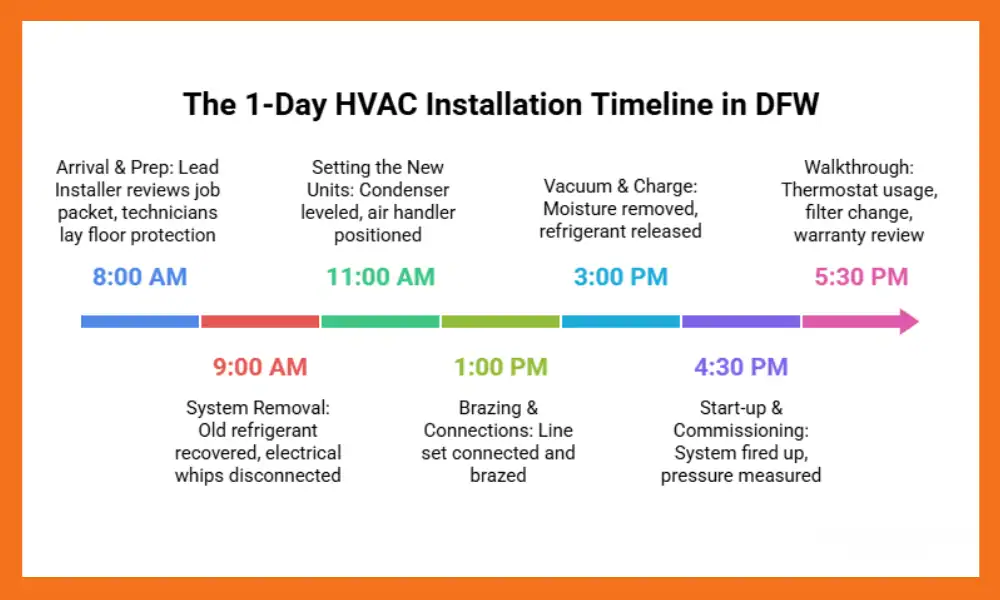
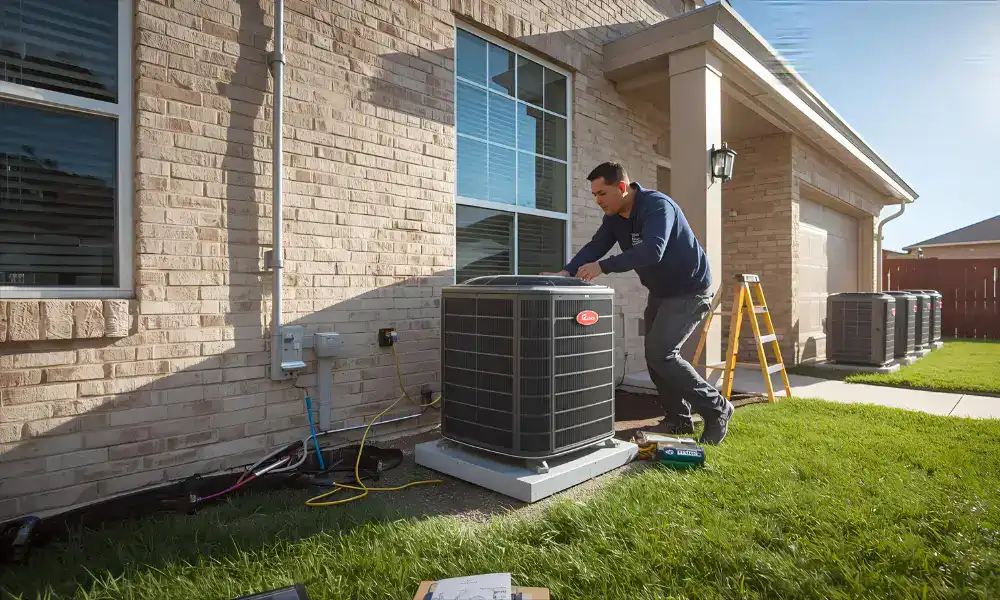
- Arrival & Prep (8:00 AM): The Lead Installer reviews the job packet. Technicians lay down floor protection.
- System Removal (9:00 AM): Technicians legally recover the old refrigerant (preventing venting into the atmosphere) and disconnect electrical whips and line sets.
- Setting the New Units (11:00 AM): The new condenser is leveled on a composite pad (elevated for drainage). The air handler or furnace is positioned in the attic or closet.
- Brazing & Connections (1:00 PM): The line set is connected and brazed with nitrogen to prevent oxidation. Electrical connections are secured.
- Vacuum & Charge (3:00 PM): A deep vacuum removes moisture from the lines before the factory refrigerant is released or topped off.
- Start-up & Commissioning (4:30 PM): The system is fired up. Technicians measure static pressure, subcooling, and superheat to ensure it meets factory specs.
- Walkthrough (5:30 PM): The crew shows you how to use the thermostat, change the filter, and review warranty paperwork.
Minor necessary modifications, like ductwork or electrical panels, can be expected on AC installation day in DFW.
The Crucial Final Step: Manual J Load Calculation and System Testing
Wait, didn’t we do the Manual J before the sale? Yes, but on the installation day, the technician verifies that the installed ductwork can handle the airflow required by the new Tonnage. System testing confirms that the unit is actually delivering the rated capacity.
Future-Proofing Your Home: Smart Tech and Refrigerant Changes
Integrating a Smart Thermostat for DFW Climate Optimization
Your new AC or heat pump is only as smart as its control. A smart thermostat is standard with most mid-to-high range installations nowadays.
- Benefit: These devices learn your schedule and can pre-cool your home before peak electricity rates kick in (critical for DFW time-of-use plans).
- Humidity Control: They can slow down the blower motor to dehumidify your home without over-cooling it.
The R-410A Phase-Out and What It Means for Your AC Unit
The industry is transitioning away from R-410A refrigerant toward lower-GWP options like R-32 or R-454B.
- Should you wait? No. R-410A systems will be serviceable for their entire lifespan.
- Future Availability: While new R-410A units will eventually stop being manufactured, refrigerant supplies for AC repairs will remain available for decades, similar to the R-22 phase-out.
Conclusion
Navigating the choice of a new AC or heat pump in DFW requires smart decisions with energy efficiency, regulatory code (14.3 SEER2), and, most importantly, the quality of installation.
The decision to choose a high-efficiency heat pump system, while perhaps having a slightly higher initial cost, is overwhelmingly supported by long-term financial benefits, including powerful Oncor Rebates and the $2,000 Federal Tax Credit (IRA). These savings help close the gap on the upfront price, ensuring lower utility bills for years to come.
Crucially, protect your investment by focusing on quality over the lowest price. Insist on a Manual J load calculation, demand proper permitting, and only hire a reputable HVAC contractor who prioritizes secure ductwork and proper system sizing. With realistic lead times of 2 to 10 days, and a predictable same-day installation process, a smooth and efficient transition to superior home comfort in Dallas-Fort Worth is entirely achievable.
Ready to secure your home’s comfort and energy future under the new Texas SEER2 standards? Contact HVAC Services Pro today for a transparent Manual J assessment and a complete, permitted installation quote.
Frequently Asked Questions (FAQs)
What is the typical total Cost range for a new AC or Heat Pump installation in DFW (2026)?
The cost for a complete AC or heat pump installation in DFW typically ranges from $8,000 to $15,000 for a standard replacement, depending on Tonnage and SEER2 rating.
How long should the Lead Time be from quote to final Install Day in DFW in peak season?
In the DFW peak summer season, the lead time from signing the contract to the day of installation is usually between 2 to 10 days, but can be longer if custom ductwork is needed.
Is a Heat Pump truly worth the extra upfront Cost in the hot Texas climate?
Yes, a high-efficiency heat pump is often worth the extra cost in Texas due to potential long-term savings on lower utility bills and eligibility for the Federal Tax Credit (IRA).
What does the DFW City Permit and Inspection process cover?
The permitting process ensures your HVAC contractor adheres to local code for electrical, mechanical, and ductwork standards, protecting the homeowner’s safety and investment.
What is the difference between SEER and SEER2, and why does it matter in DFW?
SEER2 is the new minimum standard (14.3 SEER2 in DFW) and uses a more accurate testing procedure to reflect real-world energy consumption better than the old SEER rating.
What is the most important step an HVAC Contractor must perform for proper Sizing?
The most important step for proper sizing is the Manual J load calculation, which ensures the AC unit’s tonnage is perfectly matched to the home’s specific heat loss and gain characteristics.
How can I ensure my new Ductwork is installed without major air leaks?
Ensure your HVAC contractor uses rigid connections with mastic or aerosol sealant (not just tape) and that the ductwork meets the R-8 insulation standard required in DFW attics.