

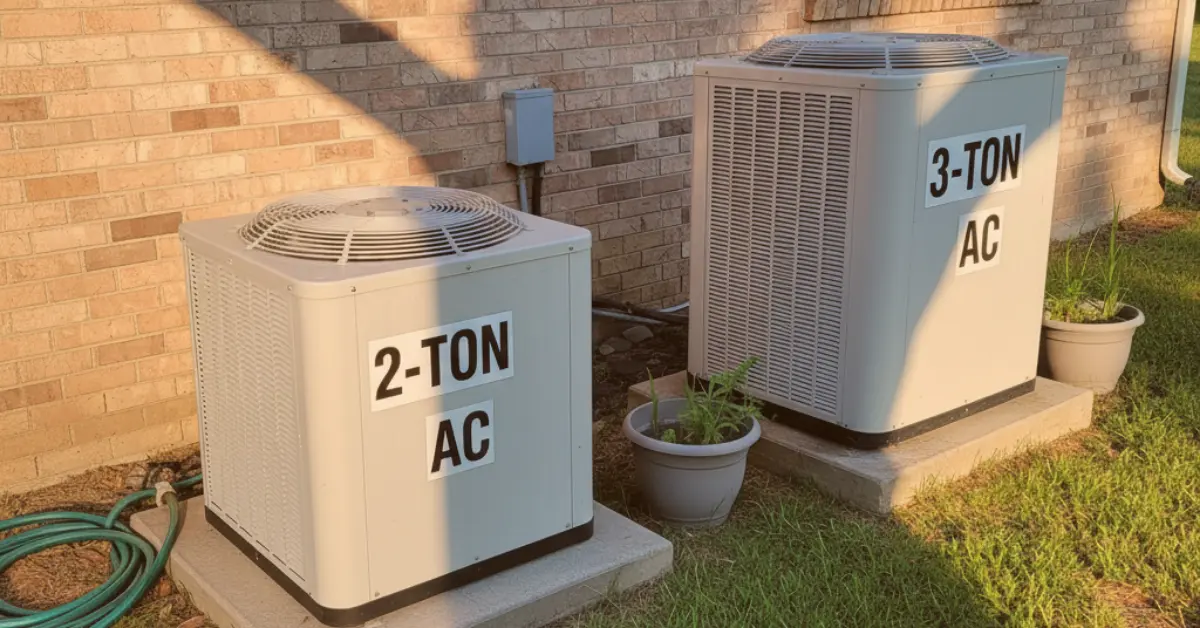
Choosing between a 2-ton and 3-ton AC system in the DFW Metroplex depends on your home’s insulation, window count, and total volume rather than just square footage. Generally, a 2-ton unit is the right choice for well-insulated homes up to 1,500 square feet. On the other hand, a 3-ton unit is better for larger spaces up to 2,000 square feet or homes with vaulted ceilings.
At HVAC Service Pro, we focus on finding the perfect balance so your system removes both heat and humidity. Our goal is to ensure your home stays dry and cool during those 100°F Dallas afternoons without wasting energy.
The BTU Breakdown: Tonnage vs. Cooling Power
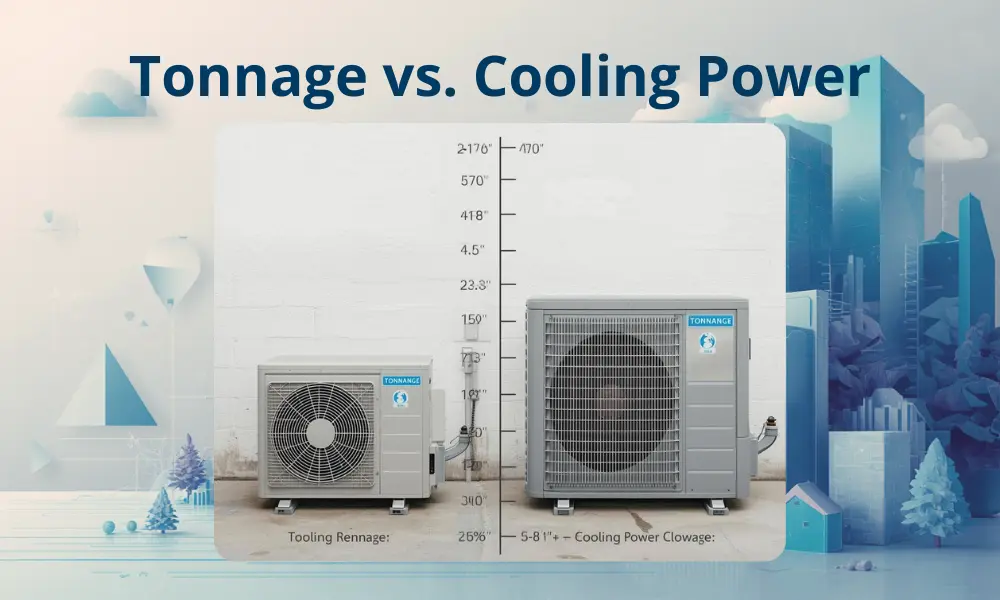
A 2-ton AC provides 24,000 BTUs (British Thermal Units) of cooling. At the same time, a 3-ton unit provides 36,000 BTUs. It makes the 3-ton unit 50% more powerful.
Some people confuse them with SEER/SEE2 ratings. (The difference between SEER and SEER2 is that SEER2 tests have much higher static pressure to simulate the restricted airflow of real-world ductwork.)
In the HVAC world, one “ton” equals 12,000 BTUs of cooling per hour. I know, it is tempting to pick the higher number. However, more power is not always better for your comfort or your wallet.
| Unit Size | Cooling Capacity | Typical DFW Square Footage |
| 2-Ton | 24,000 BTUs | 1,200 – 1,500 sq. ft. |
| 2.5-Ton | 30,000 BTUs | 1,500 – 1,700 sq. ft. |
| 3-Ton | 36,000 BTUs | 1,700 – 2,000 sq. ft. |
When a 2-Ton AC is the Winning Choice
You should choose a 2 ton AC if your home is between 1,200 and 1,500 square feet and has good insulation. It is the best choice for smaller, energy-efficient spaces where staying dry is as important as staying cool.
During my 10 years in the industry, I have seen many homeowners in Dallas County worry if their 2-ton unit is “enough.” If you have a modern building envelope with a high insulation R value, a 2-ton unit is good enough. We find that longer runtimes with 2 ton AC units are actually a good thing. Why? Because the unit stays on long enough to pull humidity out of the air.
If you’re wondering if a 2-ton unit is sufficient, I suggest you look at your attic first. High-quality attic insulation affects tonnage by keeping the heat out. This might allow you to use a smaller unit. Using a 2 ton AC for 1200 sq ft DFW homes or even for a 1500 sq ft property is common when the home is “tight.” If you are trying to find the right AC for 1200-1800 sq ft DFW homes, we always start by looking at your current insulation levels.


When a 3-Ton AC Makes Sense for Your Home
A 3 ton AC system is necessary for homes between 1,600 and 2,000 square feet. This system is also preferable for smaller homes with high ceilings and lots of windows. It provides the extra 12,000 BTU of cooling needed to fight the intense Texas sun.
When I visit homes in Collin County or Denton County, I often see 3-ton ACs in two-story houses. A two-story home tonnage decision usually leads to a 3-ton unit because heat rises. Also, high ceilings increase cooling load, making a 3 ton AC for Dallas afternoons a smart move.
If you have a 3 ton AC for a 1800 sq ft DFW home, you can keep the house at 72°F even when it is 100°F outside. However, cooling a home in the Texas sun isn’t just about the seasonal average. Pay close attention to the unit’s EER2 performance for better cooling on hot afternoons. It gives you a more accurate idea of how the unit will hold up in the peak North Texas heat.
Note: Make sure your ductwork can handle the air. A 3-ton system requires roughly 1,200 CFM (Cubic Feet per Minute) of airflow. If your vents are too small, the unit will “choke,” leading to a frozen coil.
The “Clammy Home” Syndrome: Sensible vs. Latent Heat
An oversized 3-ton unit causes a “clammy” home. The reason is that it cools the air temperature too fast to remove the humidity. It leaves the air feeling cold but damp.
Many homeowners ask why their house feels “sticky” after a new installation. This happens when the unit satisfies the thermostat (Sensible Heat) and shuts off before it can wring the water out of the air (Latent Heat). We use professional calculations to balance these two types of heat. Thus, your indoor air stays crisp and dry, not just cold.
2026 Update: Does the New R-32 Refrigerant Affect Tonnage?
The new R-32 refrigerant does not change the tonnage you need. But it does improve how well a 2-ton or 3-ton unit handles extreme heat.
You might hear about the 2026 shift to R-32 or R-454B refrigerants. These new gases are better at carrying heat than the old ones. While a 3-ton unit is still a 3-ton unit, these new systems are much more efficient on 100°F days. This means your new system will not struggle as much during a record-breaking heatwave.


Ductwork Audit: Is Your Home Ready for 3 Tons?
You cannot install a 3-ton unit if your ductwork was built for a 2-ton system, as the restricted airflow will cause the compressor to fail prematurely.
I often see homeowners in Arlington or Frisco think that “bigger is always better.” That is a myth. A 3-ton unit moves 50% more air than a 2-ton unit. If your ducts are small, the air will move too fast. It will cause loud whistling and “static pressure” issues.
Before you upgrade your tonnage, we recommend checking if your vents can handle the 1,200 CFM of air needed for a 3-ton powerhouse. This holistic approach makes sure your total HVAC system (including the furnace) is optimized. After all, everything should be in harmony, including the best AFUE rating for North Texas winters, for you to get the optimum performance.
Signs Your Current AC Is the Wrong Size
You can tell your AC is the wrong size if you have hot and cold spots, high humidity indoors, or if your summer electric bills are unusually high. These signs often mean your system is either too small to keep up or too big to remove moisture.
I often see homeowners complain about a clammy house after installing bigger AC units. This usually means the system is oversized and experiencing short cycling. On the other hand, an undersized 2 ton AC in larger home environments will lead to an AC running nonstop but still be uncomfortable. You might also notice uneven cooling from the wrong tonnage, where the living room is freezing but the bedrooms stay warm. If you are experiencing these humidity problems from oversized AC, it is time for a professional HVAC load calculation and getting the correct unit.
Can a Home Need Both? (Zoning and Separate Systems)
Many larger DFW homes actually need both a 2-ton and a 3-ton unit to handle different floors. A common setup is a 3 ton AC for Fort Worth ground floors with open living areas and a 2 ton AC upstairs bedrooms.
In many DFW Metroplex two-story homes, we see zoning vs bigger AC debates often. Heat naturally rises. This means your upstairs unit often works harder. I frequently recommend separate systems for different floors. For example, you might have a 3 ton AC for downstairs, where the kitchen and high-ceiling living room are located. Meanwhile, a 2 ton AC for upstairs handles the bedrooms.
If you have a single large system, zoning vs bigger AC setups use dampers to send air where it is needed. However, if the ductwork is small, you might face static pressure issues with bigger AC units. Splitting the load ensures you don’t have uneven cooling from wrong tonnage choices. This is why you might see a 2.5-ton unit on a 3,200-square-foot house. It is likely one of two units working together.
The Danger of the “Rule of Thumb” Sizing
You should not guess your HVAC tonnage based only on square footage because it ignores how your house actually holds heat. Professional sizing requires a Manual J calculation to look at windows, walls, and air leaks.
I often hear people ask, what square footage is good for a 2 ton AC in Texas? Many contractors say “500 square feet per ton,” but that is old thinking. In the DFW Metroplex, window solar gain increases cooling load significantly. If your home has old windows, your infiltration rate (air leakage) might be high.
An expert HVAC contractor’s sizing of a 2 ton or a 3 ton AC in DFW will include a room-by-room load calculation. This counts your sensible load (heat you feel) and latent load (humidity). You should always ask for a Manual J for the size comparison before you sign a quote. Using a Manual J Residential load calculation checklist ensures that your tech has covered everything properly.
Efficiency and Peak Heat: SEER2 vs. EER2
In Dallas and Tarrant County, the EER2 (Energy Efficiency Ratio) rating is more important than SEER2 (Seasonal Energy Efficiency Ratio) because it measures how the unit works when it is exactly 95°F outside. A high SEER2 saves money over the year, but high EER2 keeps you cool during the hottest hour.
When you compare HVAC quotes on tonnage and efficiency, you might notice a slight price jump when looking at a 14.3 vs. 15.2 SEER2 difference. While both are efficient, the higher rating often yields better long-term savings.
I also love variable speed compressor technology. Reviewing the differences between EER2 and SEER2 for North Texas can help you choose a unit that won’t give up in August.

Average Costs for DFW Homeowners
The cost to replace 2 ton AC in DFW usually ranges from $8,000 to $13,000. For a 3 ton AC installation, expect to pay between $9,500 and $16,000, depending on the efficiency level and ductwork needs.
We know that a quote for two systems reaching $30,000 can feel like a lot. However, this often includes refrigerant charge accuracy checks, new return sizing requirements, and a full commissioning checklist. Choosing the best SEER2 for 3 ton AC units can lower your electric bill, but the upfront price will be higher.
Conclusion: Making the Right Choice
To wrap up, choosing between a 2 ton and 3 ton AC in DFW is about balance. A 2-ton unit is great for smaller, well-insulated homes because it runs longer to remove humidity. A 3-ton unit is a powerhouse for larger spaces or homes with high heat gain from windows and ceilings.
Instead of guessing, always get a Manual J load calculation to get the exact requirements. Optimize your ducts, insulation, and the EER2 rating to make sure your home stays comfortable all summer long.
FAQs: Frequently Asked Tonnage Questions
Why does my AC run for 30 minutes straight in July?
This is actually a good thing! A system that runs for long periods is doing its job of removing humidity. If your unit turns off after only 5 or 10 minutes, it is likely too big for your house.
Can I use a 2-ton unit if I add solar screens to my windows?
Yes, often. Solar screens and attic insulation can reduce your cooling needs so much that a smaller, cheaper 2-ton unit becomes the perfect fit for a house that used to need 3 tons.
Why does my new 3-ton unit make a whistling sound?
Whistling usually means your ducts are too small for the amount of air the 3-ton unit is trying to push. It is like trying to blow too much air through a tiny straw.
Does a two-stage 3-ton unit help with short-cycling?
Yes. A two-stage unit can run at a lower “speed” (acting like a 2-ton unit) on most days and only use its full 3-ton power when the Texas heat is at its worst.
Does a 3-ton AC cool faster but feel worse?
It can. A 3-ton unit moves more air, but if the cycles are too short, the air stays humid. This is why people complain their house feels “clammy” after getting a bigger unit.