

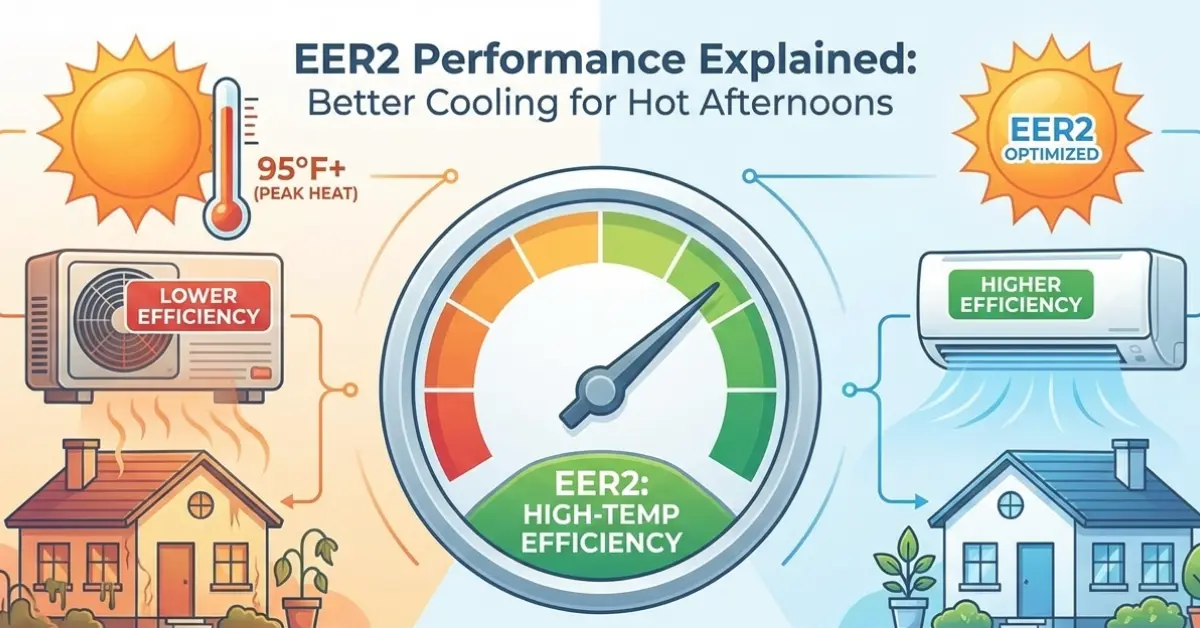
EER2 performance shows how efficiently an AC cools during hot afternoons. It measures real cooling efficiency at high outdoor temperatures.
Mainly, it calculates the cooling output per unit of electricity used at 95°F. High EER2 ratings mean lower bills and better comfort when the Texas sun hits its peak.
I remember testing HVAC efficiency data for Texas homes. Many homeowners asked why their AC struggled after 2 PM. We found that SEER ratings did not reflect real afternoon heat performance. EER2 solved that problem.
We use EER2 to understand AC behavior at 95°F and above. It helps you choose the right system for extreme heat. It also helps reduce energy bills and improve comfort.
Key Takeaways:
|
What Is EER2 Rating?
EER2 stands for Energy Efficiency Ratio 2. It represents the cooling efficiency of an HVAC system at an outside temperature of exactly 95°F. It tells you how much cooling you get for every watt of power you buy.
Systems with high EER2 ratings perform better during extreme heat. While other ratings focus on seasonal averages, EER2 focuses on the worst-case scenario. It ensures your system stays strong when the grid faces high demand.
| Feature | Description |
| Measurement | BTU per Watt Hour |
| Test Temp | 95°F Outdoor |
| Focus | Peak Load Performance |
EER2 is the updated national standard for measuring steady-state cooling efficiency. It identifies how many British Thermal Units (BTUs) a system removes per watt of electricity consumed.
The “2” in EER2 refers to new testing procedures starting in 2023. These tests use higher static pressure to mimic real-world ductwork in your home. This makes the rating more accurate for homeowners in the DFW area.
EER2 measures BTU output per watt of electricity.
Formula:
EER2 = BTU/hr ÷ Watts
It specifically tracks the BTU per watt hour at a constant full-load speed.
EER2 vs Old EER Standard
EER2 replaced the old EER with updated testing conditions. The old EER test used lower pressure. This often made units look more efficient than they actually were. EER2 ratings are typically 4% to 5% lower than EER numbers, but they reflect real-world performance.
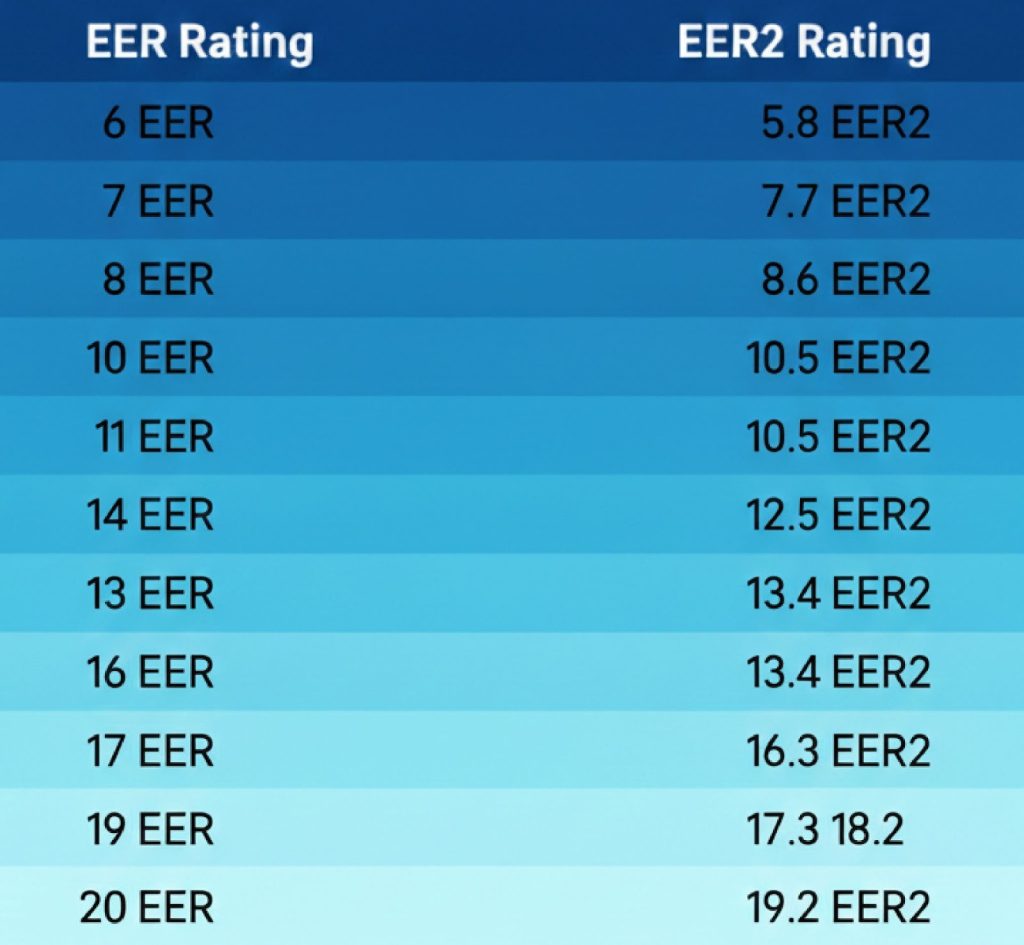
EER2 vs SEER2 for Hot Afternoons
EER2 measures how your AC performs during the peak heat of a single afternoon. SEER2 measures average efficiency over an entire season, accounting for varying temperatures.
For hot climates like Texas, EER2 is the better indicator of actual performance during a heatwave.
While SEER2 tells you how much the unit costs to run from April to October, it averages on the cool nights. EER2 focuses only on the brutal 95°F+ hours.
This is why a unit with high SEER2 might still struggle if its EER2 is low. We often see homeowners prioritize the wrong number and suffer through the hottest hours of the day.
| Feature | SEER2 (Seasonal) | EER2 (Peak) |
| Test Temperature | Varies (65°F to 104°F) | Steady 95°F |
| Speed | Often Part-Load | Full-Load Only |
| Analogy | Highway MPG | City MPG (Traffic) |
Part Load (SEER2) vs. Full Load (EER2) Efficiency
SEER2 tests AC at partial load conditions. EER2 tests full load at 95°F.Part load efficiency improves numbers in mild weather. Full load efficiency shows peak demand performance.
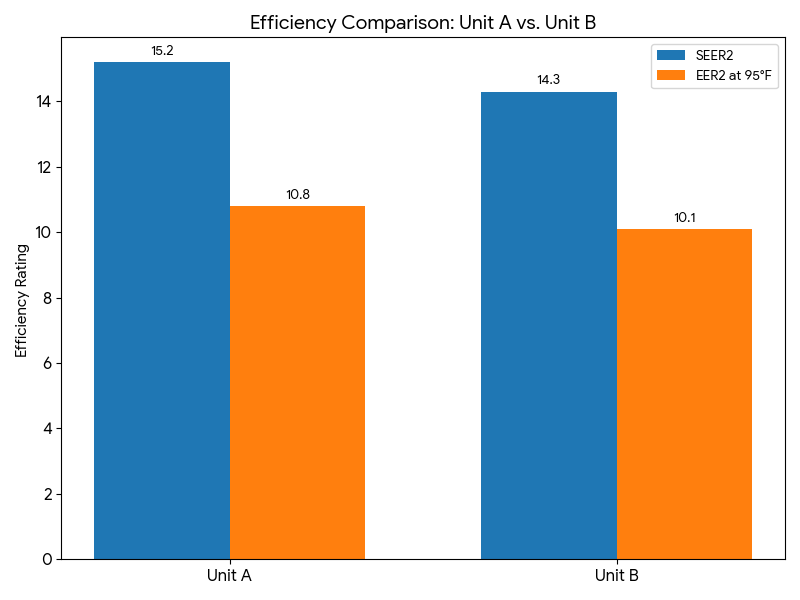
SEER2 rating allows modern inverter systems to run at slow, efficient speeds during mild 75°F mornings. EER2 forces the system to run at 100% capacity to see how it handles maximum stress.
EER2 vs SEER2 in High Heat
EER2 drops less than SEER2 in high heat.
SEER2 averages mild days, so afternoon efficiency may be lower than expected.
Unit A: SEER2 = 15.2 → EER2 = 10.8 → 29% drop in peak heat.
Data from the U.S. Department of Energy shows that AC efficiency drops significantly above the 95°F test point. Units with higher EER2 ratings typically have larger condenser coils. These coils reject heat more effectively, even when the air outside is thick and hot.
On hot afternoons, EER2 predicts electricity use better.
During these hours, EER2 vs SEER2 for 95°F becomes a critical comparison for your comfort.
If your AC has an EER2 of 10 and another has an EER2 of 12, the second unit is 20% more efficient during that specific afternoon. This can mean the difference between a 72°F living room and a 78°F living room. I always check the EER2 first for our Dallas customers.
EER2 matters more during long, hot afternoons.
Texas homeowners face peak temperatures above 95°F. Choosing AC based on EER2 reduces energy bills and improves comfort.
EER2 Performance in Extreme Heat (95°F to 105°F)
AC efficiency drops by roughly 1% to 2% for every degree the temperature rises above 95°F. A system rated for 12 EER2 at 95°F might operate like an 11 EER2 unit at 100°F.
As the air gets hotter, the pressure inside your AC increases. The compressor must work harder to remove heat from your house. High-quality systems use variable-speed compressors to better manage this pressure curve.


AC Efficiency at 95 Degrees vs. 100 Degrees
At 95°F, your system performs exactly as the manufacturer promised on the label. Once the air hits 100°F, the temperature delta between the refrigerant and the air narrows.
This narrowing makes it harder for the unit to dump heat, unlike AFUE ratings.
According to ACCA (Air Conditioning Contractors of America), capacity can drop by as much as 15% when temperatures jump from 95°F to 105°F.
We suggest looking for units that maintain at least 90% of their rated capacity at 105°F.
Understanding Capacity Derate and Compressor Amp Draw
Capacity derate is the physical loss of cooling power as the weather gets hotter. As capacity goes down, the compressor amp draw usually goes up.
The compressor works harder but accomplishes less. You can calculate this efficiency tax by monitoring your electric meter. For every 10-degree rise in outdoor heat, your unit uses 10% to 25% more energy to provide the same amount of cooling.
EER2 for Hot Climate Homes
Homes in hot climates need systems with a sensible heat focus. This means the AC is better at dropping the actual temperature rather than just removing humidity.
A high EER2 rating indicates a robust system designed for these challenges. I find that premium brands often include high-ambient kits. These kits protect the electronics from frying when attic temperatures hit 130°F.
EER2 Performance Texas / DFW / Dallas / Fort Worth
In the DFW area, we experience heat islands where concrete retains heat late into the night. EER2 performance is vital here because the peak lasts longer than in rural areas.
We recommend a minimum EER2 of 11.7 for North Texas. This meets the Energy Star requirements for our region. Systems below this level often struggle to maintain a 20-degree split between the indoor and outdoor air during a Dallas August burn.
DFW homes need units with EER2 ≥ 10.5 for peak heat. Units below this will struggle during afternoon highs.
| City | Peak Temp | Recommended EER2 |
| Dallas | 101°F | 10.8 |
| Fort Worth | 100°F | 10.7 |
| Arlington | 99°F | 10.6 |
Best EER2 Rating for Texas Summers
The best EER2 rating for a Texas summer is 12.5 or higher. This usually accompanies a SEER2 of 18 or above.
These units use two-stage or variable-speed compressors. They do not just turn “on” and “off.” They adjust their power to match the heat. This prevents the temperature swings that make your bedroom feel like a sauna every afternoon.
Should I Choose A Higher EER2 in DFW?
You should definitely prioritize a higher EER2 if your home has West-facing windows or poor attic insulation. These factors increase your afternoon heat gain significantly.
Investing in a higher rating now prevents expensive repairs later. Units that struggle in the heat die faster. I see the most compressor failures in low-EER2 systems that were pinned at 100% capacity for 10 hours a day.


Factors That Affect EER2 Performance On Hot Afternoons
Real-world performance rarely matches laboratory labels because of installation variables. Even a high-EER2 unit will fail if the home environment creates excessive resistance. I often tell my DFW clients that the equipment is only 50% of the equation; the installation quality is the rest.
Technical Factors
EER2 depends on multiple technical and design factors. High heat reduces AC efficiency if the system or installation is not optimized.
Understanding these factors helps homeowners maximize comfort and lower energy bills during peak DFW temperatures.
Compressor Efficiency Curve & Amp Draw
Compressor efficiency drops as outdoor temperature rises. At 95°F, compressors operate at peak efficiency. Above 100°F, amp draw increases, lowering EER2.
3-ton AC draws 15A at 95°F
100°F → 16.5A (+10%)
Formula: Power (W) = Voltage × Current × PF
Voltage = 240V, Current = 16.5A, PF = 0.95
Power = 240 × 16.5 × 0.95 = 3,762 W
Condensing Temperature and Capacity Drop
Higher condensing temperatures reduce AC output. As the refrigerant condenses slower, the system loses BTU output.
Formula: Capacity Derate (%) = (Rated BTU – Actual BTU) ÷ Rated BTU × 100
Rated: 36,000 BTU, Actual: 34,800 BTU → Derate = 3.3%
Condenser Fan Performance
Condenser fans move heat away from the system. Dirty or undersized fans reduce airflow, increasing condensing temperature and lowering EER2.
Clean fan: 36,000 BTU
Dirty fan: 34,500 BTU → -4% efficiency
Superheat and Subcooling Explained
Proper refrigerant charge ensures correct superheat and subcooling. Overcharge or undercharge reduces cooling capacity and lowers EER2.
Formula: ΔBTU = Rated BTU × % Deviation
Example: 36,000 × 0.05 = 1,800 BTU loss
Refrigerant Charge Affects Efficiency
AC systems with improper refrigerant charge lose efficiency quickly in extreme heat. Even a 10% undercharge reduces BTU output by 5–8%.
3-ton unit rated 36,000 BTU → 10% undercharge = 33,000–34,000 BTU
Airflow CFM per Ton
Airflow impacts EER2 directly. Optimal CFM is 400–450 CFM per ton. Low airflow reduces efficiency and comfort.
3-ton unit → 1,200–1,350 CFM required
Static Pressure & Ductwork Impact
High duct static pressure lowers AC efficiency. Leaky or poorly designed ducts cause airflow loss, increasing electricity use. Manual D duct design ensures proper delivery.
0.5 in wc → optimal
0.8 in wc → 7% efficiency loss
Dirty Filter Efficiency Loss
Clogged filters reduce airflow and cooling capacity. Dirty filters can reduce EER2 by 5–8% during peak summer afternoons.
Dirty Condenser Coil Efficiency Loss
Dirty coils increase condensing temperature. This reduces cooling output and EER2. Cleaning coils improves performance by 5–10% in Texas heat.
Attic Heat Gain
Hot attics increase indoor cooling load. For homes without attic insulation or ventilation, the AC must work harder.
Attic temp: 140°F
Cooling load increase: 10–15%
Thermostat Setpoint Effect
Higher thermostat settings reduce cooling energy use. Each 1°F increase reduces energy use by ~3% per DOE study.
72°F → 100% energy
74°F → ~94% energy

Sizing & Design Factors
If you skip this step, you are just guessing. You must learn more about how we size homes in your area and what size central air conditioner you need.
Manual J Sizing for High Heat
A Manual J Load Calculation is the only scientific way to size an AC. It considers your windows, insulation, and home orientation. Manual J ensures correct load calculation. Room-by-room BTUH prevents oversizing or undersizing.
Formula: Tons Required = Total Cooling Load ÷ 12,000
- Example: 18,000 BTU ÷ 12,000 = 1.5 tons
Oversized AC Short Cycling
Oversized AC turns on/off frequently. This wastes electricity and reduces EER2 during hot afternoons.
5-ton unit in 3-ton house → short cycles every 5–10 min
Undersized AC Capacity Drop
Undersized units run constantly but fail to maintain temperature. EER2 decreases under continuous full-load operation.
2-ton unit in 3-ton house → indoor temp remains 3–5°F above setpoint. Basically you home size decides
whether you need ton 2 or 3.
EER2 Operating Cost Explained
EER2 directly impacts your electricity bills. High EER2 units use less energy during peak summer afternoons.
Texas summers push AC systems hard. Understanding operating costs helps homeowners select the best unit and manage bills effectively.
Formula:
Cost per Hour ($)=Watts1,000Electric Rate ($/kWh)
Step-by-step explanation:
- Watts ÷ 1,000 → Converts the device’s power from watts to kilowatts, because electricity is billed per kilowatt-hour (kWh).
- Multiply by Electric Rate → Multiply the kilowatts by your electricity rate (e.g., $0.12 per kWh).
EER2 Energy Savings on Hot Days
On a 100-degree day, a high-EER2 system uses its advanced coil surface to remain efficient. For every 1-point increase in EER2, you typically save 8% to 10% on your cooling costs during peak hours.
High-EER2 units save energy when outdoor temperatures reach 95°F–105°F.
Energy savings result from reduced power draw per BTU of cooling.
Formula: Energy (kWh) = Cooling Load (BTU) ÷ EER2 ÷ 1,000
Example:
- Cooling load: 36,000 BTU
- AC EER2: 11.5
- Energy = 36,000 ÷ 11.5 ÷ 1,000 ≈ 3.13 kWh per hour
If your neighbor has an 8 EER system and you have a 12 EER2 system, your AC is effectively 50% cheaper to operate at 4:00 PM. Those savings add up fast when the Texas sun stays out for 14 hours.
EER2 Impact on Electric Bill
Your electric bill is a reflection of how many Kilowatt Hours (kWh) you use. High EER2 units keep your kWh usage low even when the AC runs at full speed. Higher EER2 lowers monthly electricity cost.
Electric bill = Energy × Rate. Use Time-of-Use rates for peak hours in DFW.
Example:
- AC runs 8 hours/day at 3.13 kWh → 25 kWh/day
- Rate = $0.15/kWh
- Daily cost = 25 × 0.15 = $3.75
- Monthly (30 days) = $112.50
An AC with lower EER2 (10.5) would use 3.43 kWh/hour → $123.00/month → +$10 extra.
Peak Demand Hours and Summer Electric Bill Spike
Peak demand usually occurs between 3:00 PM and 7:00 PM. This is when the ERCOT grid is under the most stress. Electricity rates are higher when utilities face heavy load. AC efficiency drops in high heat, increasing operating cost.
Example:
- AC with 11.5 EER2 → 3.13 kWh
- 10.5 EER2 → 3.43 kWh
- 0.30/kWh peak → 11.5 EER2 saves $0.09/hour vs low EER2
Tip:
Selecting higher EER2 saves hundreds over the summer.
Time of Use Electric Rates
Many DFW residents use Time of Use (TOU) plans. These plans offer cheap power at night but very expensive power in the afternoon. TX utilities charge more during peak hours.
High EER2 minimizes energy draw when rates spike.
Data Example:
- Peak: $0.30/kWh (3–7 PM)
- Off-peak: $0.12/kWh (9 PM–7 AM)
Calculation:
AC runs 4 hours at peak: 4 × 3.13 kWh × $0.30 = $3.76/day
Lower EER2: 4 × 3.43 × $0.30 = $4.12/day
Daily savings = $0.36 → Monthly ~ $11
How to Find and Verify EER2 Rating
You can find the EER2 rating on the yellow EnergyGuide label attached to every new unit. This label provides a clear scale to compare the unit against similar models.
For 100% accuracy, I always use the AHRI directory. This database lists the certified ratings for specific combinations of indoor and outdoor equipment. Sometimes, a mismatched indoor coil can lower your EER2 significantly.
Texas requires minimum EER2 for new installations. Minimum varies by system size and zone. For DFW: EER2 ≥ 10.2, SEER2 ≥ 14.3
Conclusion
EER2 rating shows how efficiently an AC cools in high heat. High-EER2 units save energy, improve comfort, and reduce peak-hour costs.
Texas homeowners face extreme summer afternoons. AC efficiency drops when outdoor temperatures rise. Selecting an AC with a strong EER2 ensures your system handles peak heat without overworking. Manual J sizing combined with EER2 helps match capacity to your home’s true cooling load.
Frequently Asked Questions (FAQ)
Does a higher EER2 cool better in extreme heat?
Yes. High EER2 ACs maintain cooling capacity at 95°F–105°F. They draw less electricity per BTU. This keeps rooms cooler during peak summer afternoons.
Why does my AC efficiency drop in the afternoon?
AC efficiency drops because outdoor temperature rises. Compressors work harder, and capacity derates. High EER2 models reduce efficiency loss compared to older or low EER units.
Is EER2 the same for split systems and packaged units?
No. Split systems and packaged units have different airflow and heat exchange characteristics. Always check the EER2 rating for the specific unit type.
How can I verify EER2 for my AC?Check the EnergyGuide label or the AHRI certificate. Compare the EER2 value between units to ensure efficiency meets your home’s cooling needs.