

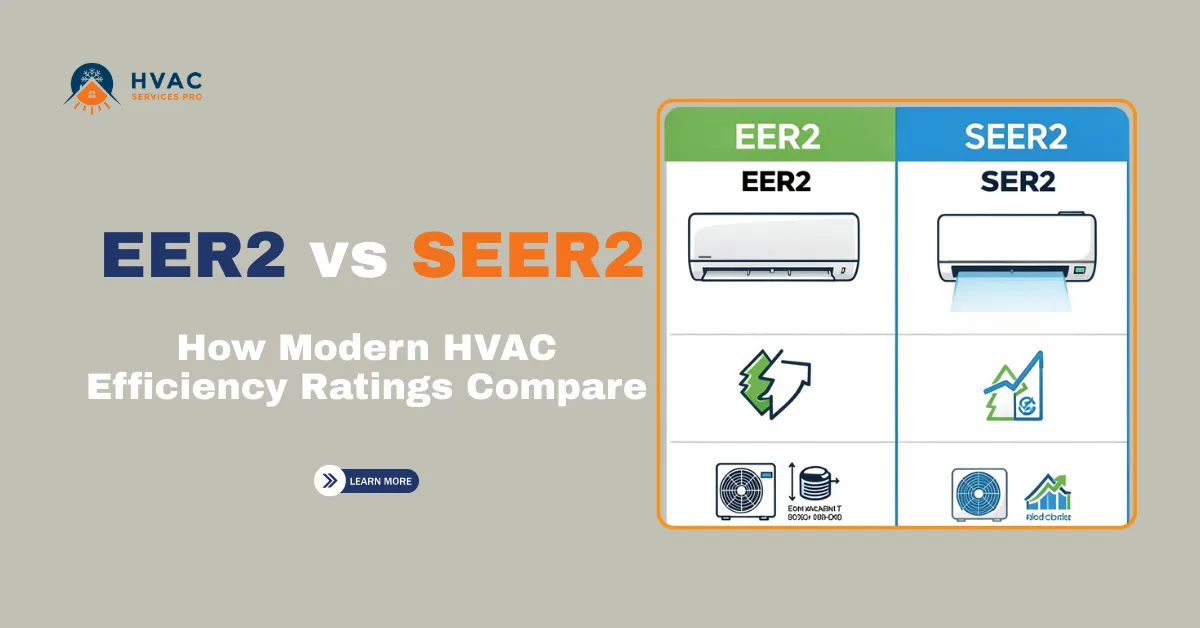
EER2 (Energy Efficiency Ratio) is the rating that matters most for brutal 95°F days in North Texas. Because it measures how your AC performs under extreme heat. Whereas SEER2 (Seasonal Energy Efficiency Ratio) only shows a seasonal average.
At HVAC Services Pro, we help you navigate these efficiency labels to ensure your home stays cool without a massive electric bill spike. This guide explains the differences between EER2 and SEER2. Moreover, you will get to know why high-heat performance is critical for the DFW climate and how to choose the right system to handle the hottest afternoons of the year.
Key Takeaways
|
What is SEER2?
SEER2 stands for Seasonal Energy Efficiency Ratio 2, the updated form of SEER. It measures the average efficiency of an air conditioner over a full cooling season. The meaning of SEER2 is based on a weighted calculation of how the unit performs across different outdoor temperatures. This ranges from mild spring days to hot summer afternoons.
You may see a SEER2 rating explained on an EnergyGuide label. It tells you how much cooling the unit provides compared to how much electricity it uses over several months. Because it is a “seasonal” metric, it includes many hours where the weather is only 82°F. This makes SEER2 a great tool for estimating your total operating cost for Texas homeowners from April to October. Understanding SEER vs SEER2 helps you see why the new “2” standard is more accurate for modern homes.
What is EER2?
EER2 stands for Energy Efficiency Ratio 2, the updated version of EER. It measures how efficiently an air conditioner cools when the outdoor temperature is exactly 95°F. Unlike seasonal averages, the EER2 meaning focuses on “steady-state” performance during the hottest part of the day.
An EER2 rating tells you the full load efficiency of the system. It is calculated by dividing the cooling output (BTUs- British Thermal Units) by the power consumed (Watts) at a fixed 95-degree outdoor temperature. For North Texas residents, this is the most critical number for comfort. While SEER2 is about your monthly budget, EER2 is about whether your system can win the fight against an August heatwave.


Regional Requirements: SEER2 and EER2 Legal Minimums
In the United States, the legal requirements for air conditioning efficiency are divided into three distinct zones. While SEER2 is a national standard, the requirement for EER2 specifically targets the hottest parts of the country.
| Region | Featured States (Full Form) | Legal SEER2 | Legal EER2 |
| North | New York, Ohio, Washington, etc. | 13.4 | None |
| Southeast | Texas, Florida, Georgia, etc. | 14.3 | None |
| Southwest | Arizona, California, Nevada, New Mexico | 14.3 | 11.7 |
The North Texas Dilemma
Texas is grouped in the “Southeast” region, where the government doesn’t legally require a specific EER2. However, the climate in Dallas, Fort Worth, Plano, and Arlington is often closer to the “Southwest” standard. Also, the Southeast region SEER2 minimum is the same as the Southwest.
Here is why you should ignore the “None” in the Texas EER2 column:
- The August Workhorse: A 100°F day in Texas is just as brutal as one in Arizona. If your unit has a weak EER2, it will lose its “cooling muscle” (known as a capacity drop in high heat) exactly when you need it most.
- The Tax Credit Rule: To get the Federal Tax Credit (up to $600 for AC), the IRS requires a minimum of 12.0 EER2. Even if it isn’t legally required to install, it is required if you want your money back.
- ERCOT Peak Hours: During peak demand ERCOT hours (usually 4:00 PM to 7:00 PM), a higher EER2 keeps your power draw lower, preventing a summer electric bill spike.
We always verify the ratings to handle the local attic heat load that North Texas summers provide.
EER2 vs SEER2: What is the Real Difference?
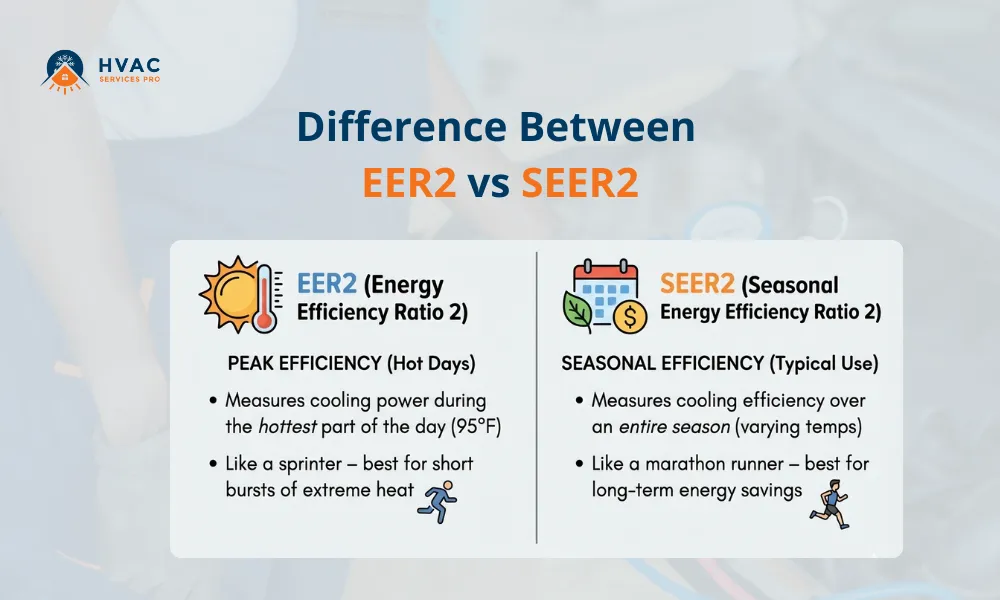
SEER2 measures average efficiency over a full season. But EER2 measures efficiency at a constant 95-degree outdoor temperature.
Think of SEER2 as the “highway MPG (Miles Per Gallon)” for your air conditioner. It is a seasonal average efficiency that includes cool nights and mild mornings. However, the EER2 is focused on “High Noon.” It is a full load rating that tells us exactly how many BTU (British Thermal Unit) per watt hour your system delivers when the heat is on.
EER2 vs SEER2 Comparison Table
| Feature | SEER2 (Cooling Season) | EER2 (Instant/Peak) |
| Main Goal | Predicts average seasonal costs | Predicts comfort on 100°F days |
| What it measures | Efficiency from Spring to Fall | Efficiency at exactly 95°F High Heat |
| Testing Temperature | Variable (mornings to hot days) | Fixed at exactly 95°F |
| Real-World Analogy | Highway MPG (Long-term Average) | Towing Power (Maximum Strength) |
| Best For | Saving money over the whole summer | Fighting the 4:00 PM “Heat Wall” |
In my years of experience, I see homeowners get caught up in high SEER2 numbers. But in a hot climate, like Dallas, Fort Worth, Plano, and Arlington, the EER2 is the real workhorse.
While the US Department of Energy sets the rules, we look at the EER2 to see if a unit has the “towing capacity” to keep your home at 72°F when it is 100°F outside. Picking the right size and efficiency for your home can lead you to long-term comfort.


Why Use the New Updates: The “2” in SEER2 and EER2
You should use the new SEER2 and EER2 ratings because they use a more accurate test procedure that reflects real-world duct static pressure (0.5 in w.c.- water column). These updates ensure the efficiency of the label actually matches how the unit performs in your attic.
I often tell my clients that the old ratings were like testing a car’s fuel efficiency on a perfectly flat track. The new “2” ratings are like testing that same car on a real road with hills and traffic. This is crucial for North Texas homes because:
- Realistic Static Pressure: Most DFW attics have ductwork that creates resistance. The new rated test conditions increase the pressure (from 0.1 to 0.5 in w.c.) to account for this.
- Accurate Savings: EER2 is a more realistic rating than the old standards. It accounts for the actual resistance your air conditioner faces when pushing air through tight or restricted ductwork.
- Better Hardware: To meet these rules, units often use a better compressor efficiency curve.
At HVAC Services Pro, with these updated metrics, we use a Manual J residential load calculation in DFW to ensure your system is sized for your actual home.
Why EER2 Wins for North Texas Summers
EER2 is the superior rating for North Texas because it reflects high heat performance during our longest, hottest afternoons. This rating helps you avoid a summer electric bill spike when the ERCOT (Electric Reliability Council of Texas) grid is under the most stress.
Dallas and Fort Worth, TX, residents often deal with “Time of Use” electricity plans. A higher EER2 ensures your system stays efficient during peak demand hours. Many people ask if a higher EER2 cools better in extreme heat. The answer is yes. Units with a high EER2 use a better compressor efficiency curve to maintain cooling power.
If you prioritize EER2 for hot days, you protect your home from the “struggle” that happens at 4 PM. We find that systems with a strong EER2 keep homes more comfortable than those that only chase a high SEER2.
How to Choose Between EER2 and SEER2

Prioritize a higher EER2 for high-heat performance in places like North Texas. However, use SEER2 to estimate your total cooling season energy savings. Choosing between these two ratings for your DFW home involves balancing peak power with seasonal averages:
- Follow Regional Requirements: In the DFW Metroplex, we must follow strict South regional standards. As our summers are long and intense, the SEER2 and EER2 requirements are much higher than those in cooler Northern states.
- Look Beyond the Minimums: When you verify EER2, SEER2, or AHRI numbers, I recommend finding a unit that exceeds the legal minimum. A system that just barely meets the standard may not provide the comfort you expect during a record-breaking heatwave.
- Balance Power and Budget: In Dallas, TX, and Fort Worth, TX, a unit with a high SEER2 but a low EER2 can still struggle. This often happens during peak demand ERCOT hours when the sun is at its strongest.
- Prevent Bill Spikes: I suggest selecting a system where both numbers are strong. This ensures you stay cool during the afternoon without facing a massive summer electric bill spike. Consult a pro with a proper understanding of HVAC efficiency ratings to select the best-suited system.
Finding the Right Capacity
When upgrading, the first thing to consider is, What size AC do I need?
Generally, a 1,200 sq ft home requires a 2-ton unit, while a 1,800 sq ft home typically moves into the 3-ton range (Varies with factors like insulation condition, number of windows, attic condition, etc).
However, because of the extreme attic heat that North Texas summers provide, a simple “rule of thumb” isn’t enough. We always use a Manual J to ensure your tonnage matches your home’s specific insulation and window exposure.
Beyond the Summer: Heating Efficiency
While we focus on the heat, don’t ignore your furnace efficiency. Understanding AFUE (Annual Fuel Utilization Efficiency) ratings helps you see that an 80% furnace is standard for our region. However, a 95% high-efficiency model offers more consistent warmth and lower gas bills during a sudden North Texas freeze.

Diagnostic: Signs Your Efficiency is Dropping
You can spot efficiency issues if:
- Your AC struggles on hot days,
- You have hot and cold spots, or
- You see a massive summer electric bill spike.
These are signs that your system is fighting its own duct static pressure or has a weak EER2 rating.
Many homeowners find that their AC runs all day, and they wonder if they need a 3-ton AC instead of a 2-ton AC. The confusion with the size here is valid. It’s not always the EER2 problem. If you notice a clammy house after a bigger AC installation, the system might be short-cycling, which ruins the efficiency of an oversized AC runtime.
Evaluating the Operating Cost: SEER2 vs. EER2 Savings
While higher SEER2 saves you money on your seasonal average efficiency, a high EER2 saves you the most on plans for electricity time-of-use in DFW. Combining both gives the lowest operating cost for Texas homeowners.
The EER2 vs SEER2 energy savings are most visible during a heatwave. While a 16 SEER2 unit is better than a 14, the difference in your August bill often comes down to the EER2. If your unit is Energy Star certified, it usually meets the SEER2 rating of 15.2 and the EER2 rating of 12.0 minimums.
Note:
Don’t let the different numbers confuse you. While the legal minimum in Texas is only 14.3 SEER2, aiming for an Energy Star level (15.2 SEER2) or the Tax Credit level (17.0 SEER2) ensures you have a 12.0 EER2. That 12.0 is the ‘muscle’ your AC needs to stay efficient when North Texas hits 100°F.
Final Thoughts
To wrap up, conquering a North Texas summer requires a two-pronged strategy. You need a high SEER2 for seasonal savings in May and June. But a strong EER2 is the only way to survive the brutal heat of July and August.
At HVAC Services Pro, we emphasize that high-heat performance is the key to maintaining comfort and avoiding a massive summer electric bill spike. By selecting a unit with a proven EER2 rating and verifying your AHRI match, you ensure your system stays a “workhorse” even when the mercury breaks 100 degrees.
Frequently Asked Questions (FAQs)
1. Does a high EER2 rating help with humidity?
Yes, because high EER2 systems often use variable-speed technology that runs longer, steadier cycles to pull more moisture from the air.
2. Can a high EER2 unit last longer?
Yes, these units are engineered to handle extreme thermal stress. It means the compressor doesn’t have to “strain” as hard during a 105F Dallas heatwave.
3. What happens if I only replace the outdoor unit?
Your efficiency will drop significantly because SEER2 and EER2 ratings require a “matched set” of indoor and outdoor coils to perform efficiently.
4. Are high-efficiency units louder during heatwaves?
No, they are actually quieter because they use sound-dampening blankets and variable-speed fans that ramp up smoothly rather than kicking on at full volume.
5. Will old ductwork “choke” a new high-EER2 system?
It can, as restricted ducts increase static pressure, forcing the blower motor to work harder and wasting the energy savings you paid for.