

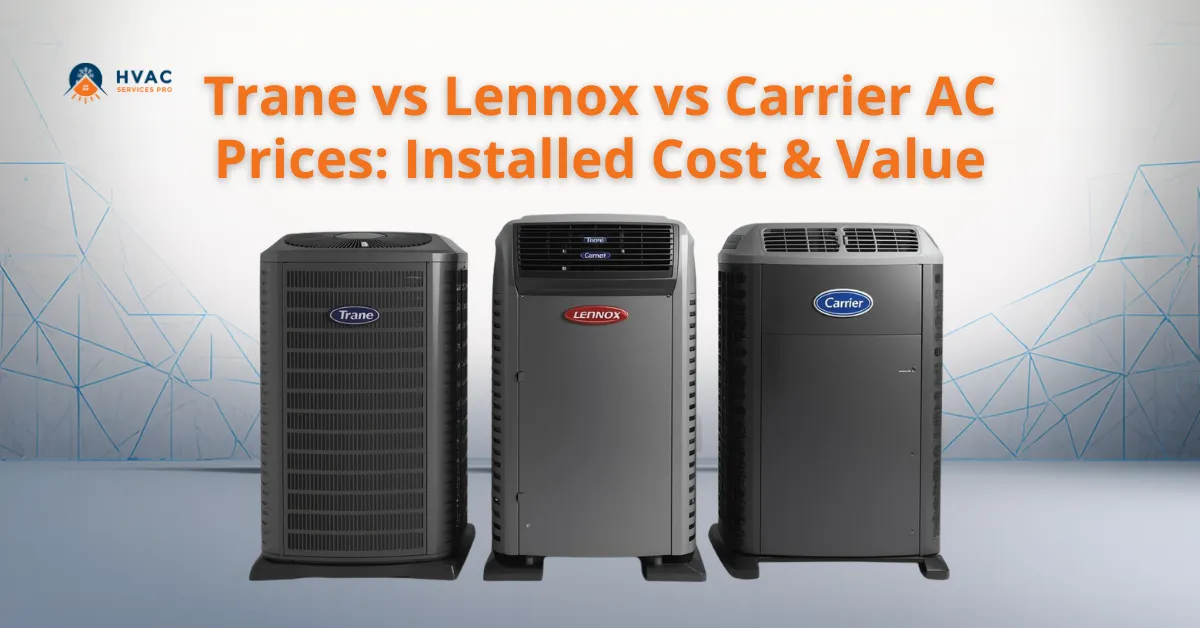
You’re about to spend $6,000–$15,000 or more on a new AC system, so it makes sense to understand what you’re paying for. Trane, Lennox, and Carrier all deliver quality, but prices vary by model, efficiency, and installation.
This guide will help you see how costs break down, what upgrades affect price, and how to weigh features and long-term value. By the end, you’ll know which system fits your home and budget without confusion or guesswork.
TL;DRIn DFW (2026), Trane typically starts higher than Lennox and Carrier, but whether you’re paying more or getting more depends on installation quality, SEER2 level, system size, and long-term durability, not just brand price. |
Trane, Lennox, Or Carrier: Which Brand Typically Starts Higher in DFW?
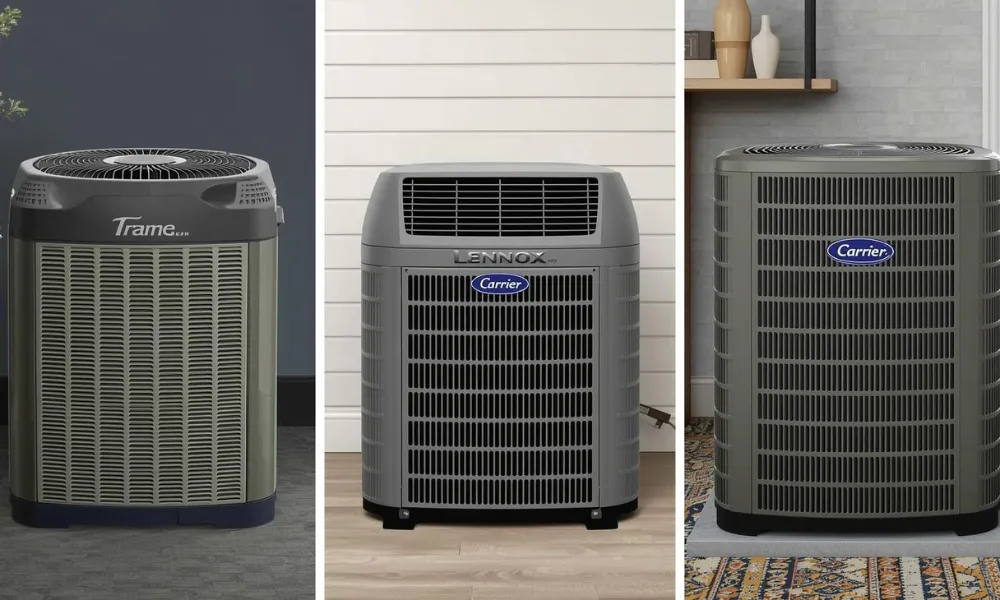
In DFW for 2026, the cost of Trane AC units is more than the other two. Lennox systems come next, slightly lower, and Carrier usually starts at the lowest price point. The differences are modest and mainly reflect market positioning, installation, and maintenance.
Equipment vs Installed Price
The equipment-only price covers just the outdoor condenser and indoor coil. In DFW, this usually ranges $3,000–$7,000 depending on brand and SEER2 level.
The installed price, on the other hand, includes labor, permits, refrigerant, startup testing, airflow balancing, and warranty registration. This comprehensive price is what most homeowners encounter in a complete quote.
Typical Installed Pricing for 2.5–3.5 Ton Systems in DFW (2026)
| Brand | Typical Installed Range |
| Trane | $6,000 – $12,000 |
| Lennox | $6,500 – $13,000 |
| Carrier | $5,500 – $12,000 |
Carrier may start slightly lower, while Trane and Lennox can appear higher, but that doesn’t mean they’re harder or more expensive to install. What matters most is the full installed price, including labor, permits, testing, and any add-ons.
Why Installed Quotes Differ Even When the Systems Look Similar
Installation steps are nearly the same for all three brands: removing the old unit, setting the new condenser and coil, charging refrigerant, completing electrical connections, and testing the system.


The small price differences usually come from dealer practices:
- Many Trane and Lennox dealers in DFW include extra items(They insist on items of premium quality) in their base quote, like new line sets, upgraded pads, electrical disconnects, or detailed startup testing.
- Some Carrier dealers include these too, while others list them as optional add-ons.
This is why a Trane or Lennox quote might appear higher than a Carrier’s quote, even for the same size and efficiency.
For better understanding, we present a comparison table for a 3-ton system with a standard efficiency of approximately 15.2 SEER2 in the DFW area.
| Brand & Model | Equipment Only (Condenser + Coil) | Full Installed Price (DFW Average) | Why the difference? |
| Trane XR15 | $4,000 – $5,500 | $10,800 – $16,400 | Trane dealers often include high-end filtration or specialized duct transitions in their base quotes. |
| Lennox Merit ML17XC1 | $3,500 – $5,500 | $8,500 – $16,000 | Lennox quotes vary widely; “Elite” dealers bundle extensive testing and premium thermostats. |
| Carrier Comfort 15 | $3,800 – $4,800 | $7,500 – $11,000 | Carrier has more “no-frills” installers in DFW, leading to lower starting points for basic change-outs. |
Price Per Ton Breakdown: How System Size Affects the Cost
When purchasing an AC system, the capacity or size also affects the overall cost. Here’s how Trane’s size-cost comparison is with two other brands.
1.5–3 Ton Systems (Smaller to Mid-Sized Homes)
For homes with 1.5-ton to 3-ton systems, the price difference between Trane, Lennox, and Carrier is usually relatively close. These systems are considered smaller, which means:
- Less material is required for manufacturing.
- Lower electrical load is needed.
- Simpler handling during installation.
For a 1.5-ton system in DFW, a Trane XR14 costs about $3,500 for equipment. Full installation ranges from $6,999 to $8,500, depending on features like advanced filtration.
A Lennox Merit ML14XC1 starts slightly lower at $3,200 for equipment. Installed prices range from $6,500 to $8,000 and often include premium thermostats and efficiency upgrades.
The Carrier Comfort 14 is the most budget-friendly. Equipment starts at $2,800, and full installation is around $6,500. It provides solid performance without extra features. At this size, Carrier usually has the lowest price.


4–5 Ton Systems (Larger Homes)
For larger homes, a 4-ton or 5-ton system is typically required, and prices increase with the system’s size. The higher costs reflect the need for greater capacity, as well as more complex installations. Here’s why:
- A higher electrical load is needed for the larger system.
- More refrigerant is required.
- Heavier equipment needs more handling.
- Possible ductwork adjustments or structural changes.
For a 4-ton system, a Trane XR16 costs about $5,500 for equipment. Full installation ranges from $11,500 to $14,000, reflecting its premium features and strong reputation.
A Lennox Elite XC21 starts around $4,800 for equipment. Installed prices are between $10,500 and $13,000, often including smart thermostats or advanced filtration.
The Carrier Comfort 16 is the most budget-friendly. Equipment starts at $4,200, with full installation ranging from $9,500 to $13,000. It delivers reliable performance at a lower upfront cost.
At this size, Trane and Lennox are usually more expensive due to added features. Carrier provides a more budget-friendly option.
How to Ensure an Accurate Price Comparison: AHRI Matching and Manual J Verification
Before comparing prices, always verify that the condenser and coil are AHRI (Air-Conditioning, Heating, and Refrigeration Institute) matched. If they aren’t, pricing and performance expectations can be misleading.
Just as important, confirm that the system size was determined using a proper Manual J load calculation. Manual J evaluates your home’s square footage, insulation levels, window exposure, ceiling height, and air leakage to determine the correct tonnage. Without it, systems are often oversized or undersized.
Here’s how to ensure you’re comparing the right system:
- Match the tonnage of the condenser and coil.
- Confirm they are AHRI-certified as a paired set.
- Ask whether a Manual J load calculation was performed.
- Align the installation scope with what your home actually requires.
A lower quote without AHRI matching or load verification does not represent a true cost comparison. Inaccurate sizing can increase energy use, reduce comfort, and shorten system lifespan. Always confirm performance certification and load calculation before evaluating price differences.
SEER2 Levels and Price Differences by Brand: How Much More Does Higher Efficiency Cost?
The SEER2’s impact on Trane’s prices shows up in both equipment and installation costs, as higher SEER2 ratings increase pricing. As efficiency rises from entry-level models to high-performance variable-speed systems, costs climb due to advanced compressors, smart communication controls, and upgraded performance features that enhance comfort and improve energy savings.
Entry-Level (14–15 SEER2)
At the base efficiency range, the price differences between Trane, Lennox, and Carrier are minimal. For a 14 SEER2 system, the prices between Carrier, Lennox, and Trane are generally similar, with slight variations based on dealer offerings, installation packages, and equipment price.
Mid-Range (16–17 SEER2)
The price difference between Trane and Lennox for a 16 SEER2 system may become more apparent. Lennox is typically priced a bit higher due to proprietary parts and industry-leading efficiency. Trane typically falls in the middle of the premium tier. And Carrier remains competitive in pricing.
High-Efficiency (18–20+ SEER2)
The most significant price jump occurs when moving beyond 18 SEER2. At this level, brand positioning is defined by variable-speed technology.
Lennox and Trane typically command the highest premiums for their ultra-high efficiency engineering and proprietary communication Gazeways.
While Carrier offers sophisticated Greenspeed® technology that competes directly with these brands, it often provides a slightly better value-to-performance ratio, though it remains a significant investment compared to mid-range models.
AC Model Comparison: Trane, Lennox, and Carrier by Tier, Features, and Price
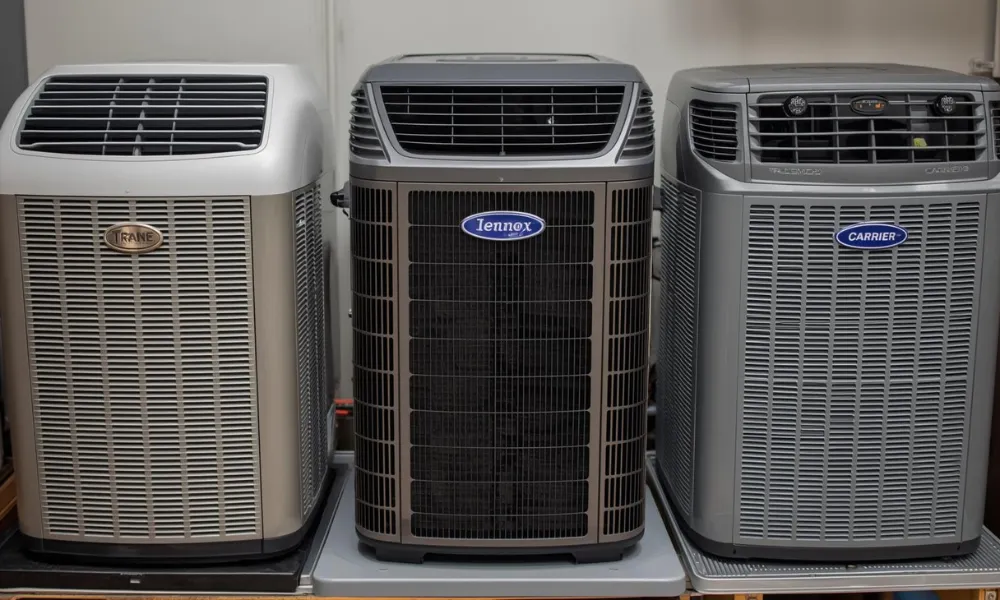
AC system prices vary by model tier, reflecting the features and performance each brand offers. For example, Trane has XR, XL, and XV series for different budget ranges. However, most manufacturers have a common theme: Trane focuses on long-term durability and precision, Lennox emphasizes efficiency, and Carrier balances performance with affordability.
Entry-Level Models
Trane XR, Lennox Merit, and Carrier Comfort are single-stage systems. They run at a fixed output and provide reliable cooling without advanced features. Pricing mainly reflects brand reputation and dealer practices, not performance differences.
Mid-Tier Models
Trane XL, Lennox Elite, and Carrier Performance use two-stage compressors. This allows smoother cooling, better humidity control, and quieter operation. Brand differences appear here: Trane offers more customizable control, Lennox focuses on efficiency, and Carrier emphasizes quiet performance.
Premium Models
Trane XV, Lennox Signature, and Carrier Infinity feature variable-speed or inverter compressors. They provide precise temperature control, superior humidity management, and low noise. Trane and Lennox are generally higher priced for advanced engineering. Carrier Infinity delivers a strong balance of performance and cost.
Performance vs Price: What Do You Actually Get for the Difference?
Trane, Lennox, and Carrier all build premium variable-speed air conditioners designed for quiet, steady cooling. All three brands operate in the 51 to 59 decibel range, which is about the sound of light rainfall or a quiet conversation. That means you will barely hear the system unless you are standing right beside the outdoor unit. The real-life pricing for AC units reflects the varying levels of comfort.
On paper, Carrier often posts the lowest number, with some Infinity models rated as low as 51 dB. Trane typically falls between 55–57 dB with the XV20i, while Lennox lists around 59 dB for the XC25. The measurable difference exists, but for most homeowners, it is subtle.

Comfort and Humidity Control
The bigger difference appears in how each brand modulates capacity.
Trane’s XV20i is known for extremely precise control. It can adjust output in 0.1% increments with up to 700 speeds. That allows the system to fine-tune cooling and hold indoor temperatures within about half a degree of the thermostat setting. The result is very stable comfort with minimal temperature swing.
Lennox’s XC25 uses 65 speeds with 1% increments. It does not adjust as granularly as Trane, but it still delivers smooth, even cooling. Lennox also pushes efficiency strongly, with some of the highest published SEER ratings in this category. That focus appeals to homeowners who prioritize maximum rated efficiency.
Carrier’s Infinity 19VS operates differently. It uses fewer distinct speed stages, but it can drop as low as 25% capacity, which is the lowest minimum operating point among the three.
Key Feature Specifications
| Feature | Trane XV20i | Lennox XC25 | Carrier Infinity 19VS |
| Lowest Noise Level | 55–57 dB | 59 dB | 51–56 dB |
| Modulation Range | 30%–100% | 35%–100% | 25%–100% |
| Speed Increments | 700 speeds (0.1%) | 65 speeds (1%) | 5 speeds |
| Max Efficiency | Up to 22 SEER | Up to 26–28 SEER | Up to 26 SEER |
In simple terms, Trane leads in precision control, Lennox leads in peak published efficiency ratings, and Carrier often leads in the lowest sound rating and the lowest minimum capacity.
Warranty, Reliability, and 10-Year Ownership Comparison
Trane, Lennox, and Carrier all have similar standard warranties. Typically, they offer 10 years for parts and compressors with registration. So, warranty alone doesn’t distinguish them. The key differences are in reliability, serviceability, and long-term performance.
- Trane is built for long-running. Its Spine Fin™ coils and Climatuff™ compressors can last 15–20 years, even in extreme heat.
- As, we already know, Lennox focuses on energy efficiency, and it uses specialized parts. It can make repairs more expensive and parts harder to find in some areas.
- Carrier delivers reliable performance with widely available parts and a large service network. This often results in the lowest total 10-year ownership cost.
In practice, repair costs over a decade depend more on installation quality than brand, but Carrier is often the most convenient for long-term service, while Trane provides the most long-lasting option.
How to Choose the Right AC in DFW
For DFW homeowners, the best AC depends on what matters most: durability, efficiency, or long-term value.
- Choose Trane if you want long-term structural durability.
Choose Trane systems if you want long-term structural durability. You are comfortable paying more upfront for heavy-duty components and a long service life, making these systems best suited for homeowners staying 10–15+ years who prioritize building strength over the lowest entry price - Choose Lennox if your focus is maximum rated efficiency.
You are aiming for the highest SEER2 performance and potential energy savings, and you are comfortable with premium-tier pricing and advanced technology. - Choose Carrier if you want balanced cost and service convenience.
You prefer a competitive starting price, wide parts availability, and predictable long-term maintenance costs.
If two quotes are properly sized using Manual J, AHRI-matched, and based on the same tonnage and efficiency tier, the performance difference will be minimal. At that point, the decision is less about which brand is “better” and more about what you value most. So choose based on your long-term plans, upfront budget flexibility, and ownership priorities.
Final Recommendation
At HVAC Service Pro, we recommend Trane for along-lasting system and comfort. It’s the best choice if your priority is a system built to last with comfort.
But, choose Lennox if maximum efficiency and energy savings are most important. Or, opt for Carrier if you want solid performance, easy service, and a balanced combination of cost and convenience.
For DFW homeowners, our local HVAC professionals are ready to answer questions and guide you in selecting the right system. We also ensure proper installation so you can enjoy reliable comfort for years.
FAQ
What factors increase AC installation cost the most?
System size, SEER2 rating, ductwork condition, and electrical upgrades increase cost the most. Bigger units require more materials and refrigerant. High-efficiency systems use advanced components. Older homes often need additional electrical or duct modifications.
How much does AC maintenance cost per year?
AC maintenance typically costs $200 to $500 per year in DFW. This usually includes seasonal inspections, cleaning, and system testing. Regular maintenance reduces repair risk and improves efficiency.
How often do Trane, Lennox, and Carrier systems need repairs?
Most systems require minor repairs 1–3 times over 10 years when properly installed. Repair frequency depends more on installation quality and maintenance than brand name. Proper airflow and refrigerant setup matter most.
When should you replace your AC instead of repairing it?
Replace your AC if it is over 12–15 years old or if repair costs exceed 30–40% of replacement value. Frequent breakdowns and rising energy bills are also warning signs. In DFW’s long cooling season, older systems lose efficiency faster.
Does a higher SEER2 rating lower electricity bills in Texas?
Yes, a higher SEER2 rating can reduce cooling costs by 15–30% compared to base models. Savings are more noticeable in larger homes and during long Texas summers. The benefit increases with higher usage.
Does a new AC increase home value in DFW?
Yes, a new AC system improves buyer confidence and resale appeal. While it may not return the full cost, it reduces inspection concerns and signals lower future utility bills to buyers.
What is the most important factor when comparing AC brands?
The most important factor is installation quality, not the brand name. Correct sizing, airflow setup, and refrigerant charging affect comfort and lifespan more than the logo on the unit.